Field Notes from Indonesia — Volume 1
Amanda Hillary Husain is Bytecenture's Indonesia-based payment UX researcher. This is the first in a series of Field Notes from our in-market researchers across ten countries.
A high checkout drop-off rate in Indonesia does not always mean low purchase intent. In many cases, users have already done the hard part — they found the product, added it to cart, and even reached checkout. The problem is that checkout itself is often where value comparison, trust concerns, and friction become most visible. Indonesian users do not always abandon checkout because they have changed their minds. They often abandon it because the final payment experience no longer feels like the best deal, the easiest option, or the safest moment to proceed. This matters even more in Indonesia, where digital payments — e-wallets, QRIS, virtual accounts, and BNPL — now dominate e-commerce transaction value. Over 80% of urban Indonesian consumers actively use e-wallets like GoPay, OVO, DANA, and ShopeePay for online purchases, which means checkout UX is effectively the only payment surface that determines whether a high-intent user completes a transaction.
The most distinctive Indonesian behaviour at this stage — and the one global platforms most consistently misread — is cross-platform comparison at the last mile.
The comparison happens at checkout, not before
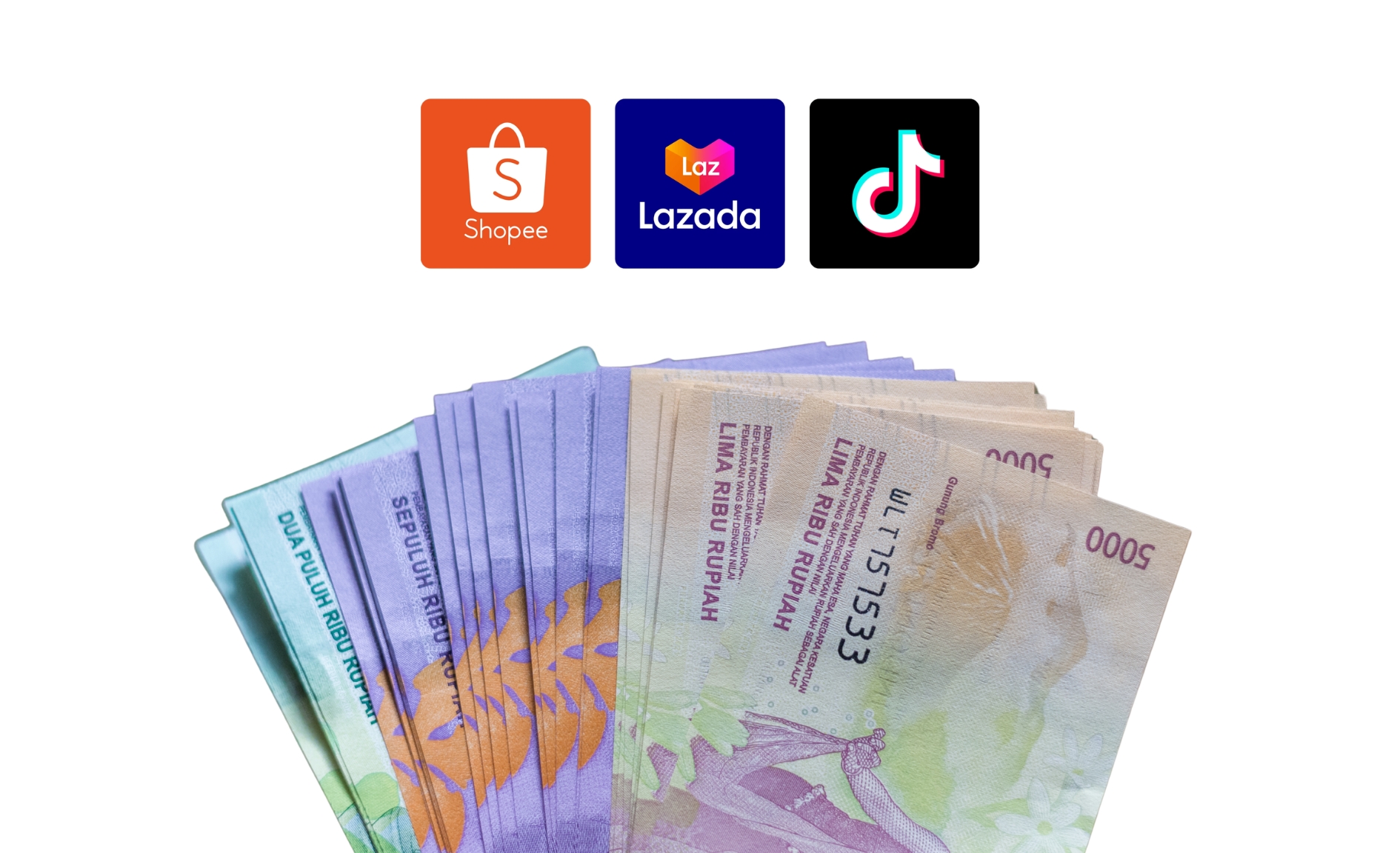
Many Indonesian users are highly familiar with multiple e-commerce apps and know how to optimise for total cost. A user shopping for a single item may add it to cart across Shopee, TikTok Shop, and Tokopedia simultaneously, then walk each platform all the way to the final checkout screen before deciding which one to actually complete. What they are comparing at that final screen is not the product price — that was already comparable on the listing page. They are comparing the combined effect of shipping fees, voucher eligibility, cashback rules, platform-level promotions, and payment-method-specific discounts. Only the checkout screen surfaces all of those at once.
The platform that offers the best final total wins the transaction. The others see what looks like a high-intent user abandoning at the worst possible moment. From a platform's analytics view, this looks like a funnel failure. From the user's view, this is the comparison engine working exactly as intended.
For global platforms shipping checkout into Indonesia, the operational implication is sharp: a 50% drop-off rate at final checkout is not necessarily a 50% intent failure. It may be a 50% loss to a competitor whose final-total maths were better. Treating it as a UX problem and redesigning the flow does nothing if the underlying issue is that another platform's bundled discount stack added up to a lower number.
The second-largest driver: price inconsistency between cart and checkout
The other recurring failure mode is the gap between what users expect to pay and what they are shown to pay. Users enter checkout anchored on a total that included visible product price, an applied voucher, and an estimated shipping figure from the cart screen. The final checkout total then increases — because shipping recalculated, because a service fee was added, because a voucher that appeared valid earlier no longer applies, or because a payment method carries a surcharge the cart did not surface.
This is not a minor issue. Baymard Institute's research on US online shoppers has consistently found that around one in four (23%) abandon their cart because they cannot see their total order cost upfront — a specific manifestation of the broader pattern in which late-revealed extra costs (shipping, taxes, fees) drive nearly half of all checkout abandonments globally. In the Indonesian context, where users are highly promo-sensitive and often compare the final payable amount across apps, late-stage price movement is especially damaging.
Even when the difference is small, the psychological effect is disproportionate. Users feel misled, forced to recalculate, or pushed into a less attractive deal than the one they thought they were taking. The result is the same — abandonment — but the underlying cause is trust, not friction.
Other contributing factors
Beyond comparison shopping and price inconsistency, several smaller factors weaken checkout conversion in Indonesia consistently:
The most-trusted local payment method may be missing, buried, or shown in the wrong order in the payment method list. Indonesian users have strong preferences here — BCA Virtual Account, BRI Virtual Account, GoPay, DANA, OVO, ShopeePay, and Shopee PayLater are not interchangeable, and presenting them in the wrong priority order for a given user segment introduces friction at exactly the wrong moment.
The flow may require too many steps, app switches, or OTP actions. Indonesian users have learned to expect compressed payment flows from the local wallets; any platform that requires more taps than DANA or GoPay does for an equivalent transaction loses on perceived effort.
The payment page may feel unfamiliar or lack trust signals appropriate to the local context. Visual cues that signal trust to a user in São Paulo or Manila do not necessarily signal trust to a user in Jakarta or Surabaya.
When a payment attempt fails — for any reason, including ones outside the platform's control like a temporary bank-side issue — recovery is often weak. Many platforms drop the user back to an earlier screen with no clear retry path. Users simply leave instead of starting over.
What is still open
A few questions are worth flagging for any platform planning Indonesian checkout investment in 2026 and 2027.
First, the relative weight of the comparison-shopping abandonment versus the price-inconsistency abandonment differs sharply by category. For high-ticket purchases (electronics, fashion at higher price points), comparison shopping dominates. For low-ticket frequent purchases (groceries, daily essentials), price inconsistency dominates. A diagnostic that treats both abandonments as one problem will misallocate the fix.
Second, the Indonesian voucher and cashback ecosystem is meaningfully more complex than the equivalent in most regional markets. Bank-issued vouchers, wallet-issued vouchers, platform-issued vouchers, and payment-method-specific cashback can all stack — or fail to stack — in ways that the user cannot easily predict. Whether the right response is to surface the stacking rules more clearly at the cart stage, to remove the complexity entirely with simpler bundled pricing, or to lean into the complexity as a competitive surface, is genuinely open. Each path implies a different product strategy.
Third, the device and connectivity context matters more in Indonesia than the headline statistics suggest. A user comparing three checkout flows on a mid-range Android device over a 4G connection in a non-Jakarta city is making the comparison under different latency and battery conditions than a user in a major-city Wi-Fi environment. Optimising checkout speed for the former is a different problem than optimising it for the latter, and the user research that informs the optimisation needs to reflect this.
What this means for global platforms
For platforms shipping checkout into Indonesia, the practical 2026 question is not how to reduce friction at the final payment step in the abstract. It is how to be the platform whose final-total maths consistently wins the last-mile comparison, while keeping the path from cart to confirmation predictable and short. The flows that perform best in this market make the final price predictable, keep promotions consistent from cart to checkout, surface the most relevant local payment methods in the right priority order, and provide clear recovery paths when a payment attempt fails.
Indonesian users are not abandoning checkout because they don't want the product. They are abandoning it because checkout has given them one final reason to choose another platform — or one final reason to feel that the deal they are being offered is not the one they signed up for. Both are solvable. Neither is solved by treating checkout drop-off as a generic funnel problem.