Field Notes from Brazil - Volume 9
Lucas Albuquerque Gouveia de Lima is Bytecenture's Brazil-based payment UX researcher. This is the ninth in a series of Field Notes from our in-market researchers across ten countries.
The hardest part of wallet adoption is often not opening the account.
It is giving the customer a reason to care.
A conventional wallet onboarding flow asks the user to accept terms, verify an identity, create a PIN, and add money before the product has delivered much value. That is a difficult sequence, especially when the user already has Pix, cards, and another banking app that works.
Commerce platforms can approach the problem from the other direction. They can begin with a transaction the user already wants to make, then position the wallet as the easiest or most rewarding way to complete it.
The financial relationship starts with utility, not a financial-services pitch.
The Transaction Creates the Reason
Shopee's 2025 partnership with Casa Ronald McDonald Brasil is a useful example.
Customers could buy digital Big Mac vouchers for McDia Feliz through the Shopee app, supporting services for children and adolescents undergoing cancer treatment. Customers who paid with ShopeePay received 50% cashback, applicable to purchases of up to R$50, for future use.[1]
The mechanics connected three kinds of value:
- an immediate, familiar product
- participation in a charitable campaign
- a financial reward that remained inside the commerce ecosystem
The important detail is not simply the size of the cashback. It is what the reward asked the user to do next.
Cashback held in a wallet creates a reason to return. The customer who came to buy a Big Mac voucher now has a balance to spend, an account to revisit, and a lower-friction route into the next transaction.
This should not be overstated. The voucher could be purchased through the Shopee app, while the cashback was the ShopeePay-specific incentive. The public material does not establish how many customers activated a wallet for the first time, how many funded it, or how many became retained users.
It does show how a desirable purchase can become a distribution surface for a financial product.
From ShopeePay to Maree
The broader product direction makes the example more interesting.
ShopeePay began as a wallet inside the Shopee app. Users could add money through Pix or boleto, pay for marketplace purchases, receive refunds, and transfer funds. In December 2025, Shopee announced deeper Pix integration, including sending and receiving money through the wallet.[2, 3]
In September 2026, ShopeePay evolved into Maree, a broader digital account available both inside Shopee and through a dedicated app. Existing balances, Pix keys, transaction history, and limits remained attached to the same account. The account also became a distribution point for products such as SParcelado and SCrédito for eligible users.[4, 5]
The McDia Feliz campaign did not, by itself, cause that evolution. But the sequence illustrates a wider platform strategy:
- Start with an existing commerce relationship.
- Attach a payment benefit to a transaction the customer already understands.
- Give the resulting balance a reason to stay inside the ecosystem.
- Expand the wallet into transfers, credit, account services, and a standalone financial destination.
Checkout is not only where the wallet is used. It can be where the wallet is first understood.
The Real Advantage Is Relationship Ownership
The original temptation is to describe proprietary wallets as a way to eliminate card-network fees and control the entire experience.
That is too absolute.
A wallet still depends on funding rails, settlement infrastructure, identity verification, fraud controls, regulation, and customer support. Pix, cards, boleto, and external bank accounts may all remain part of the journey. The platform does not control 100% of the system.
What changes is ownership of the customer relationship.
When value remains in the wallet, the platform can reduce the number of times the customer has to choose a payment method. It can connect payments with refunds, rewards, transfers, credit, and account history. It can also design the next transaction around a known balance rather than starting from an empty checkout every time.
That continuity is strategically valuable even when external rails remain underneath it.
The strongest wallet is not necessarily the one with the longest feature list. It is the one that becomes useful often enough to earn a place in the customer's routine.
Onboarding Should Begin With Value
For product teams, the lesson is not to disguise account opening as a purchase.
It is to order the experience correctly.
Lead with the benefit the customer came for. Explain why activating the wallet is relevant to that benefit. Show what account is being created, which terms apply, what verification is required, how money enters and leaves, and what happens to cashback or remaining balance.
The wallet step should feel connected to the transaction without becoming invisible.
A strong activation journey answers five questions before the customer commits:
- What do I receive now?
- Am I opening or activating a financial account?
- Do I need to add money, or can I use an existing payment method?
- Where will cashback, refunds, or unused balance remain?
- Can I withdraw or transfer the money later?
The language should reflect the customer's immediate goal. "Use your balance and receive cashback" is clearer than "activate a payment account." But benefit-led language should not remove the financial meaning of the action.
Good onboarding lowers cognitive load. It does not lower informed consent.
The First Deposit Is Not the Success Metric
Promotion-led acquisition can produce impressive activation numbers while hiding weak retention.
If users activate only to collect a discount, then withdraw the balance or never return, the campaign acquired a subsidized transaction rather than a durable wallet relationship.
Product teams should follow the journey beyond activation:
- activation completion rate
- first funding or first wallet-payment success
- time from activation to the first completed transaction
- use of cashback or refunds
- second transaction without the original incentive
- 30- and 90-day wallet reuse
- balance withdrawal and stranded-balance rates
- movement from marketplace payment into Pix, transfer, or another account service
The most revealing metric is the second unprompted use.
That is the point where the wallet begins to move from campaign mechanic to customer habit.
What Is Still Open
Several questions remain.
First, the 2026 McDia Feliz partnership used a different mechanic: Shopee-funded coupons of up to 30% on digital vouchers, without publicly presenting ShopeePay as the required reward rail.[6] That change is a reminder that a single campaign does not establish a permanent acquisition strategy.
Second, commerce-led activation can create a trust problem if customers do not realize they are opening or activating a regulated payment account. The smoother the handoff becomes, the more important disclosure, consent, and balance portability become.
Third, the economics are not visible from the outside. Cashback, coupons, verification, fraud, support, and compliance all carry costs. A promotion can reduce onboarding friction without proving that the acquired wallet user is economically sustainable.
Finally, a marketplace advantage may weaken once the wallet becomes a standalone destination. Maree can inherit Shopee's distribution, but it must still establish a reason to be used when the customer is not shopping.
The Bottom Line
The best wallet onboarding does not begin by explaining the wallet.
It begins with a transaction the customer already wants to complete.
Shopee's McDia Feliz partnership shows how a familiar, emotionally meaningful purchase and a future-use reward can bring a financial product into an existing commerce journey. The later evolution from ShopeePay to Maree shows the larger ambition: turn a payment feature inside checkout into an account that can support activity beyond it.
The product opportunity is real, but so is the responsibility.
Make the first use valuable. Make the account activation explicit. Make the balance easy to understand and move. Then measure whether the customer comes back when the subsidy is gone.
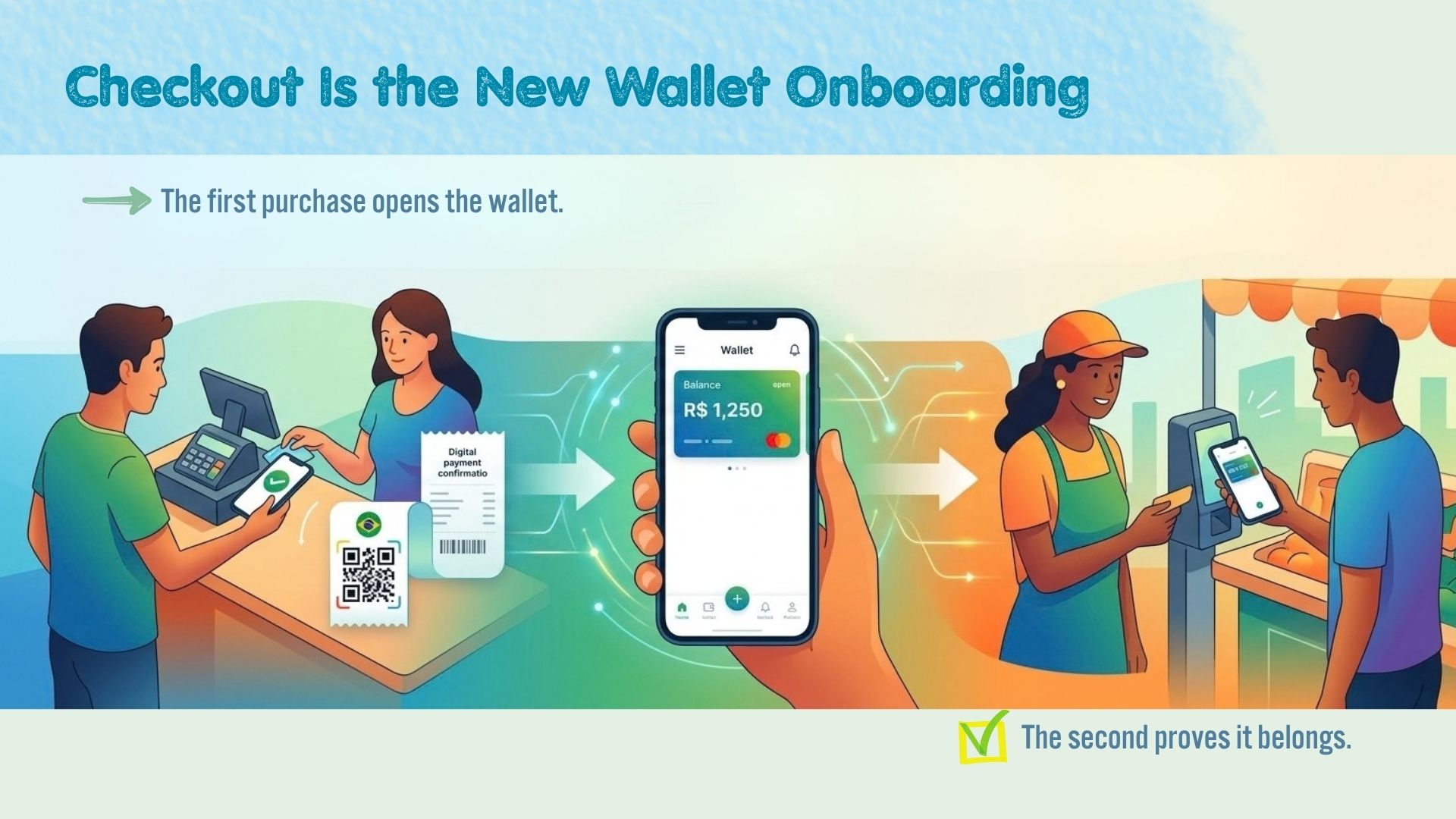
The first purchase can open the wallet.
The second one proves whether the wallet belongs.
References and Sources
- Casa Ronald McDonald Jahu. McDia Feliz 2025 Has an Unprecedented Partnership with Shopee. Source for digital Big Mac vouchers in the Shopee app and 50% cashback for customers paying with ShopeePay on purchases of up to R$50. casaronaldmcdonaldjahu.org.br
- ShopeePay Brasil. ShopeePay. Source for wallet activation, adding money through Pix or boleto, marketplace payments, refunds, transfers, and PIN use. shopeepay.com.br
- Shopee Brasil. Shopee's Digital Wallet Now Has a Pix Key. Source for the December 2025 expansion of ShopeePay into Pix transfers, payments, and receiving money. shopee.com.br
- Shopee Brasil Help Centre. What Is Maree? Source for Maree's account functions and the connection to SParcelado and SCrédito for eligible users. shopee.com.br
- Shopee Brasil Help Centre. Questions About the New Maree App. Source for account continuity between Shopee and Maree, including balances, Pix keys, transaction history, limits, and app-specific services. shopee.com.br
- Casa Ronald McDonald Brasil. Casa Ronald McDonald Brasil Renews Alliance with Shopee for McDia Feliz 2026. Source for the 2026 campaign's Shopee-funded coupons of up to 30% and digital-voucher purchase flow. casaronaldmcdonaldbrasil.org.br
- Banco Central do Brasil. Payment Institutions. Source for the regulatory role and operating model of payment institutions in Brazil. bcb.gov.br