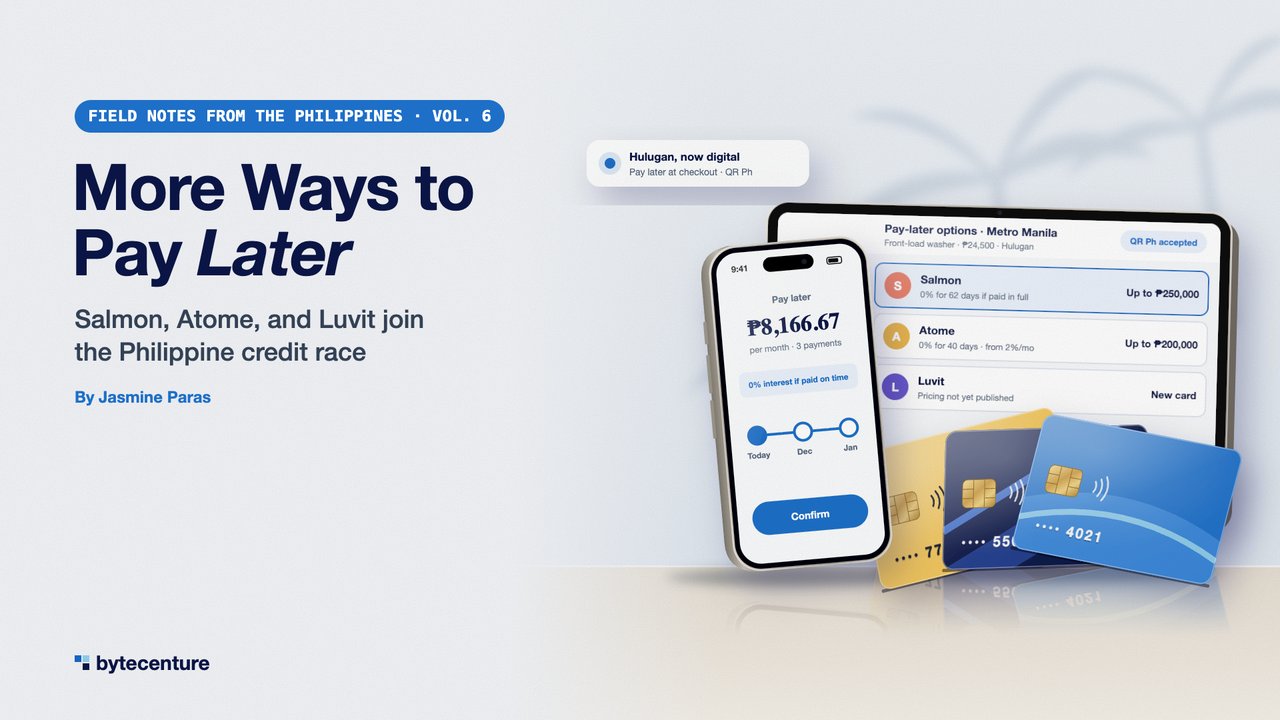
Field Notes from the Philippines - Volume 6
Jasmine Paras is Bytecenture's Philippines-based payment UX researcher. This is the sixth in a series of Field Notes from our in-market researchers across ten countries.
In short: Salmon, Atome, and Luvit are three newer buy now, pay later (BNPL) lenders in the Philippines. Salmon pairs an SEC-registered financing company with a BSP-licensed rural bank. Atome lends through a financing company and delivers credit on a prepaid card issued by Asia United Bank (AUB). Luvit, from the operator of the JuanHand loan app, attaches a Mastercard to a lending company's credit. These structures shape what borrowers pay and which rules apply.
Why Are Pay-Later Options Growing in the Philippines?
Pay-later options are growing because Filipinos are shifting to formal lenders while bank credit cards remain hard to get.
Paying in installments is not new. Hulugan has long been how Filipinos buy phones and appliances, and Home Credit says it has served 12 million customers through about 18,000 partner stores [1]. What has changed is delivery: credit now arrives through e-wallets, marketplace checkouts, lending apps, and cards.
According to the Bangko Sentral ng Pilipinas (BSP) 2025 Consumer Finance and Inclusion Survey, 25% of adults had outstanding loans, down from 45% in 2021, but formal borrowing (16%) now outpaces informal borrowing (10%) [2, 3]. GCash's lending arm, Fuse, alone reports ₱451 billion disbursed to 11.5 million borrowers [4].
Bank credit cards remain out of reach for many. Only 23% of adults hold a bank account [5], entry-level cards require ₱10,000 to ₱15,000 in documented monthly income [6, 7], and about a third of workers are not wage earners [8]. World Bank Global Findex data put credit card ownership at around 3% of Filipino adults, while industry figures report 18.5 million outstanding cards [9, 10]. The figures measure different things: the former counts individuals who report owning a credit card, while the latter counts cards, including multiple cards held by one person. They are therefore not directly comparable.
How Are Salmon, Atome, and Luvit Structured?
Salmon, Atome, and Luvit all extend credit through SEC-regulated financing or lending companies, but their wider financial structures differ. Salmon also operates through an affiliated BSP-licensed rural bank, while Atome and Luvit use bank partnerships to support their card products. These arrangements help explain how each company delivers credit and which regulatory requirements may apply.
Who lends. All three lend through companies registered with the Securities and Exchange Commission (SEC). Lending and financing companies can extend credit but cannot take deposits [11, 12]. SEC Memorandum Circular 20, effective 1 August 2026, reopened licensing for online lending platforms and tied required capital to the number of platforms a company runs [13, 14].
Who issues the card. A Mastercard logo shows the payment network, not who extends the credit.
- Atome describes its card as a prepaid card backed by AUB, with BNPL credit provided by Atome [15, 16].
- Luvit runs on Mastercard with AUB as sponsor bank; credit comes from WeFund Lending Corp. [17, 18, 19].
Which Interest Rate Caps Apply to Pay-Later in the Philippines?
The applicable interest rate limits depend on the underlying credit product and the entity providing it. However, publicly available documents reviewed for this article do not conclusively establish how the BSP's credit card interest ceiling applies to the specific pay-later arrangements offered by Atome and Luvit.
The BSP sets a 3% monthly finance-charge ceiling for covered credit card transactions [22]. Whether this ceiling applies to the particular non-bank financing arrangements behind Atome and Luvit's card products cannot be determined conclusively from the publicly available materials reviewed. Separately, SEC Memorandum Circular 14 caps small loans of ₱10,000 or less, over four months or shorter, at 12% a month effective interest, with total charges capped at 100% of principal [23]. Larger balances fall outside it.
Salmon vs Atome vs Luvit: How Do They Compare?
| Salmon | Atome | Luvit | |
| Lender | Salmon Finance Inc., financing company [24] | NeuronCredit Financing Company Inc. [25] | WeFund Lending Corp., lending company [17] |
| Linked bank | Owns Salmon Bank, a rural bank [26] | AUB issues the prepaid card [15] | AUB as sponsor bank [19] |
| Network | Not disclosed; QR Ph [20] | Mastercard [25] | Mastercard [18] |
| Published pricing | Up to ₱250,000; 0% for 62 days if paid in full; later rate set per account [20, 21] | Up to ₱200,000; 0% for 40 days; installments from 2% a month, APR 0–36% [25, 27] | Up to ₱200,000; 0% interest for up to 40 days; installment plans up to 6 months with interest. Specific installment rates and fees not publicly confirmed [39] |
| Scale (company-reported) | "Millions" of app users [28] | 3 million+ cards issued [29] | Not disclosed |
Salmon is a lender with a bank attached. Founded in 2022 by former Tinkoff executives, it launched with point-of-sale installment loans in 2023 [30, 31]. In 2024 it bought a controlling stake in a rural bank, now Salmon Bank, which takes deposits [26, 32]. It most recently raised $140 million in October 2026 [28]. Deposit funding is not necessarily cheap. Salmon previously promoted time-deposit rates as high as 8.88% [33], although that historical offer should not be confused with its current rates or overall cost of funding.
Atome delivers BNPL on a prepaid card. Part of Singapore's Advance Intelligence Group, it launched its card with AUB in 2022 [34, 35]. Installments start at 2% a month, with processing fees of up to 2.24% and a 5% monthly late fee; repaying by card or e-wallet can cost up to 2.24% more than paying over the counter [25, 27]. Atome reports more than 3 million cards issued and a ₱5 billion credit facility from AUB [29].
Luvit is a cash-loan operator adding a card. It is the card brand of WeFund Lending Corp., which also runs the JuanHand app and is part of FinVolution Group [19, 36]. Announced in April and launched publicly in May 2026, Luvit offers a physical and virtual Mastercard aimed at making credit accessible to first-time borrowers [18, 37]. Its website advertises spending limits up to ₱200,000, up to 40 interest-free days, and installment plans of up to six months. Specific installment rates, loan volumes, and active user numbers have not been publicly confirmed [39].
None of the three publishes market share, loan volume, or default rates, so no leader can be named yet.
What Should Borrowers Watch For?
The biggest risk is the price after the free period. Among Filipino adults with loans, 34% say they often have difficulty paying and 8% borrow to repay existing loans [3].
- The price after the free period. "0% interest" applies only when the full balance is paid on time. Salmon does not publish its post-grace rate [20].
- Regulatory applicability. BSP and SEC interest-rate rules cover different types of credit. Publicly available information reviewed for this article does not conclusively establish which credit-card interest ceilings apply to each non-bank pay-later arrangement.
What Should Product Teams Do?
The competition among Salmon, Atome, and Luvit raises several questions worth investigating through product research and usability testing:
- Pricing comprehension. Can borrowers accurately identify their total repayment amount, including interest and fees, before choosing an installment plan?
- Repayment experience. Do users notice differences in repayment-channel fees, and how do these influence their choice of payment method?
- Lender transparency. Do borrowers understand which company provides their credit, issues their card, and handles repayment concerns?
- Credit-limit management. How do increases, reductions, or unexpected changes to credit limits affect user trust and continued usage?
These are research opportunities rather than established usability findings. As pay-later products become more similar, clarity, transparency, and repayment experience may become increasingly important differentiators.
Frequently Asked Questions
Is Atome a traditional bank-issued credit card? No. Atome describes its product as a prepaid card issued by AUB, with buy now, pay later credit provided through Atome's financing arrangement [15]. It offers some credit-card-like features, but its underlying structure differs from a conventional bank-issued revolving credit card.
Is Salmon a digital bank? No. Salmon's lender is an SEC-registered financing company, and its bank, Salmon Bank, is a BSP-licensed rural bank [24, 26].
Who is behind Luvit? Luvit is the card brand of WeFund Lending Corp., operator of the JuanHand app and part of FinVolution Group [19, 36].
What is the interest cap on small loans in the Philippines? For unsecured loans of ₱10,000 or less over four months or shorter, SEC Memorandum Circular 14 caps effective interest at 12% a month [23].
The Bottom Line
Salmon, Atome, and Luvit all promise easy credit to Filipinos that banks have struggled to serve. So do GCash's Fuse, Home Credit, and BillEase, so an easy application alone will not separate them for long.
What differs is how each company builds and distributes credit: Salmon combines consumer lending with an affiliated rural bank, Atome expands BNPL through a bank-supported card, and Luvit brings an established cash-loan operator into card-based payments.
Their next challenge is not simply making credit accessible, but making its costs, terms, and repayment experience clear enough for borrowers to use responsibly. For product teams, that raises important questions about pricing comprehension, transparency, and trust—areas where competitive research and usability testing can provide valuable evidence.
References and Sources
- Technobaboy. Home Credit reaches 12 million customers in the Philippines. 12 September 2025. technobaboy.com
- Philippine Information Agency. BSP survey shows gains in youth and women's financial access, formal lending, financial literacy. 2026. pia.gov.ph
- GMA News. BSP: Filipino account ownership down to 50% in 2025, household access up to 85%. 2026. gmanetwork.com
- Daily Tribune. Fuse targets credit gap with P451B in loans. 8 September 2026. tribune.net.ph
- Philippine Daily Inquirer. Filipino financial account ownership slips — BSP survey. 17 April 2026. business.inquirer.net
- Philippine National Bank. Credit card application form. 2026. pnb.com.ph
- BDO Unibank. Credit card application requirements. Accessed November 2026. bdo.com.ph
- GMA News. Jobless Filipinos increased slightly to 2.26M in December 2025 —PSA. 6 February 2026 (PSA Labor Force Survey). gmanetwork.com
- Manila Bulletin. Visa: Philippines among ASEAN's weakest in credit card penetration. 15 July 2026 (Visa report citing Findex 2024). mb.com.ph
- Philippine Star. Credit card use in Philippines still low despite growth. 22 January 2026 (CCAP data). philstar.com
- Securities and Exchange Commission. Implementing Rules and Regulations of RA 9474, Lending Company Regulation Act of 2007. sec.gov.ph
- BatasNatin. Republic Act No. 10881 (amending RA 9474 and RA 8556). 2016. batasnatin.com
- Securities and Exchange Commission. SEC Memorandum Circular No. 20, Series of 2026. 7 July 2026. sec.gov.ph
- Credisense. The Philippines Reopens Online Lending: What SEC Memorandum Circular 20 Asks of the Next Generation of Digital Lenders. August 2026. credisense.com
- Atome Help Center. What is Atome card? Accessed November 2026. help.atome.ph
- Atome. Atome Card Membership Terms and Conditions. 15 May 2023. atome-paylater-fe.s3-accelerate.amazonaws.com
- Apple App Store. Luvit x Junahand (app listing). Accessed November 2026. apps.apple.com
- BusinessMirror. Mastercard and FinVolution Group launch Luvit Card to expand access to digital credit in PHL. 15 April 2026 (company release). businessmirror.com.ph
- BusinessWorld. Finvolution partners with AUB to launch a flexible payment card in the Philippines. 14 May 2026 (company release). bworldonline.com
- Salmon. Salmon Credit product page. Accessed November 2026. salmon.ph
- Apple App Store. Salmon app listing. Accessed November 2026. apps.apple.com
- GMA News. BSP retains maximum 3% per month interest rate on credit card transactions. August 2023. gmanetwork.com
- Manila Bulletin. SEC caps interest rates on small loans at 12% monthly. 11 December 2025 (SEC MC 14-2025). mb.com.ph
- Salmon. Our Story. Accessed November 2026. salmon.ph
- Google Play. Atome PH- Card, Loans, Savings. Listing updated 29 October 2026. play.google.com
- Salmon. Salmon Bank. Accessed November 2026. salmon.ph
- Atome Help Center. Do you charge any fee for Atome card? Accessed November 2026. help.atome.ph
- Manila Times. Fintech secures $140M to extend loan business. 20 October 2026. manilatimes.net
- BusinessWorld. Atome Philippines gets P5-billion credit facility from AUB. 10 July 2026. bworldonline.com
- TechCrunch. Salmon raises $100M in equity and debt to bring digital credit to underbanked Filipinos. 23 April 2026. techcrunch.com
- Fintech Futures. Filipino fintech start-up Salmon lands $20m debt funding. 21 July 2023. fintechfutures.com
- Fintech Futures. Southeast Asian fintech Salmon acquires controlling stake in Filipino bank. 10 January 2024. fintechfutures.com
- Philippine Daily Inquirer. Consumer-focused fintech Salmon gets $88-M fresh capital. 18 June 2025. business.inquirer.net
- TNGlobal. Atome Philippines secures $81M credit facility from Asia United Bank to expand PayLater card. 14 July 2026. technode.global
- BusinessWorld. AUB, Atome launch BNPL credit card. 2 September 2022. bworldonline.com
- JuanHand (WeFund Lending Corp.). Licenses and Partnerships. Accessed November 2026. juanhand.com
- Daily Tribune. Luvit launches push for financial inclusion. 7 May 2026. tribune.net.ph
- BatasNatin. Republic Act No. 9510, Credit Information System Act. 31 October 2008. batasnatin.com
This article is a research summary, not legal or financial advice. Product details and regulatory status reflect sources reviewed as of November 2026.