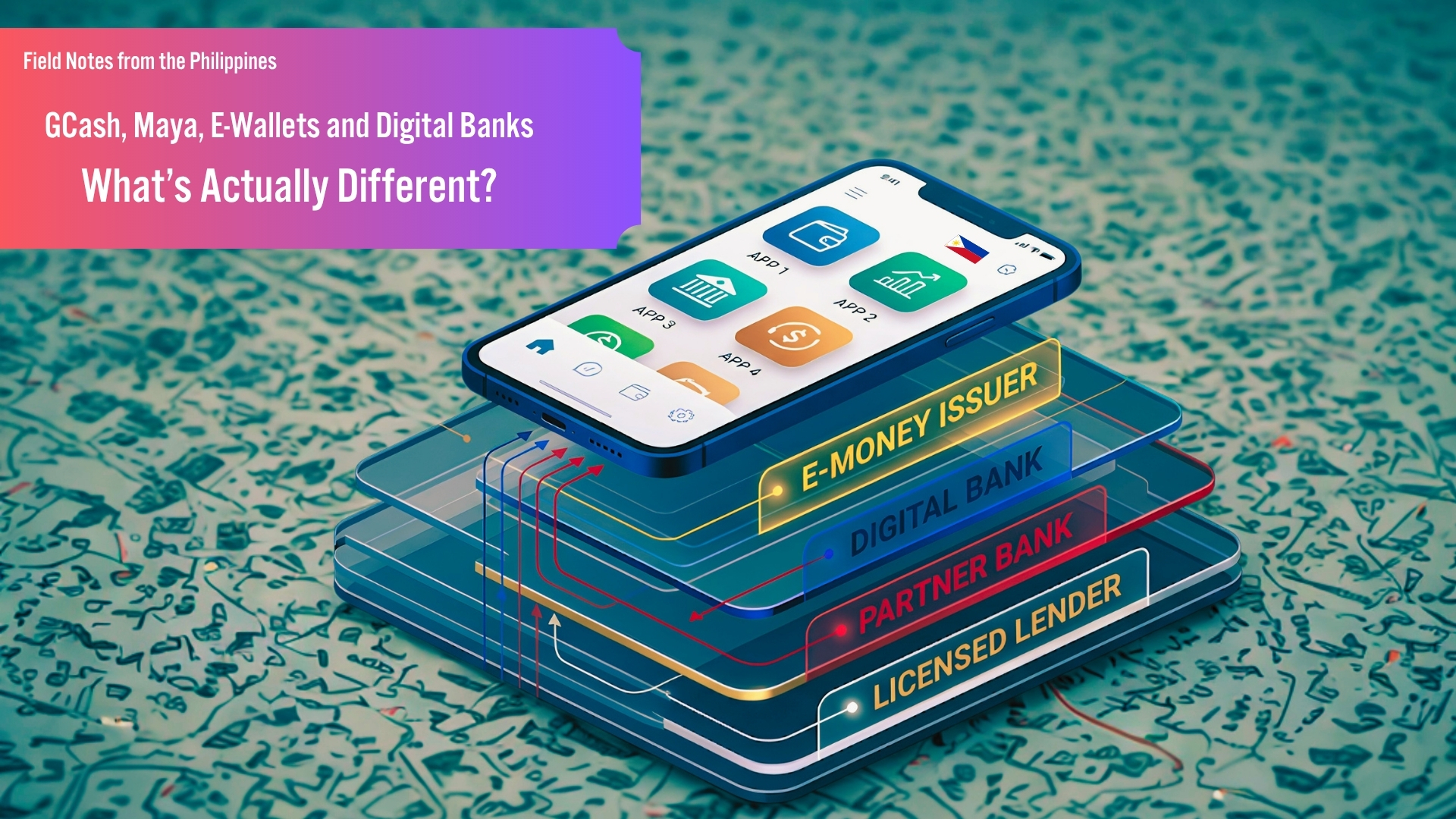
Field Notes from the Philippines — Volume 3
Jasmine Paras is Bytecenture’s Philippines-based payment UX researcher. This is the third in a series of Field Notes from our in-market researchers across ten countries.
Many Filipinos now hold more than one financial app, and on the home screen they look interchangeable. GCash and Maya sit side by side. Maybe GoTyme or MariBank is there too. All of them take cash-ins, scan QR Ph codes, move money in seconds, and offer some form of savings and credit.
What actually separates them is not the interface. It is the regulatory status of the legal entity holding or lending the money behind each feature, and that status decides what the product is allowed to do.
What the difference feels like to a consumer
Nobody experiences a license. They experience its side effects, and those surface in about seven places.
| Moment | Non-bank e-wallet | Digital bank |
| At cash-in | The destination. Topping up commonly means switching apps, since proprietary linked accounts were retired in early 2026 as transfers moved onto InstaPay. The fee fell over the same period, from P15 to P10 at GCash in July 2026 | The source. Money leaves here to reach the wallet, and it is where balances often sit when not being spent |
| At rest | The e-money balance itself cannot bear interest. That is a legal property of e-money, not a product decision | Can accept deposits directly. Particular savings products may pay interest according to their terms |
| At the ceiling | Providers set account and transaction limits under their own risk frameworks and product terms. Circular 1166 removed the old P100,000 aggregate monthly load limit, so these are not a universal regulatory cap | No general regulatory balance cap. The P1 million line is an insurance ceiling, not a limit |
| When you save | A non-bank EMI cannot turn its e-money float into a deposit. Savings shown inside the app are held by a licensed bank entity | Holds deposits directly under its own license |
| When you borrow | Credit is provided by an affiliated or partner licensed lender rather than out of e-money float. The actual creditor appears in the disclosure statement | Can originate loans directly under the bank's license |
| When something goes wrong | The e-money balance is not a PDIC-insured deposit | Eligible deposits are PDIC-insured up to P1 million per depositor, per bank |
| At checkout | Broadly the same experience. Both scan QR Ph, and interoperable retail payments are the design intent | Broadly the same experience |
The last row is the point. What a customer touches at the moment of payment says very little about which legal entity is holding their money, whether it is insured, or who is actually lending to them.
What each one is legally allowed to do
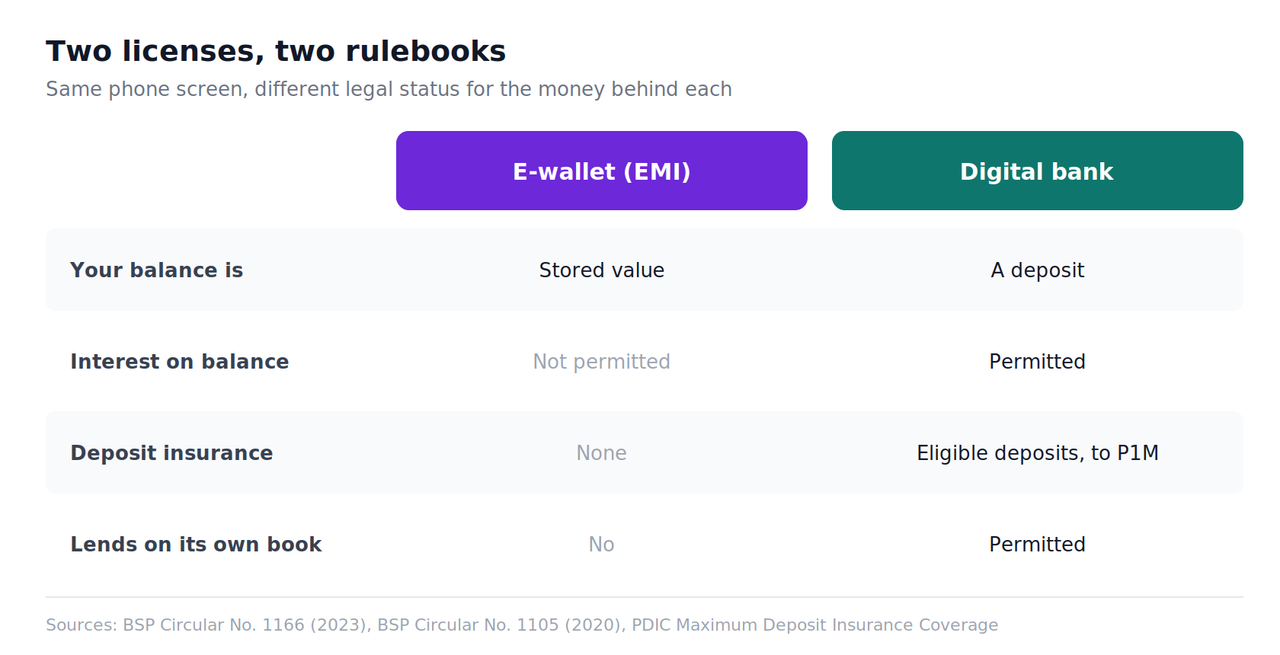
Under BSP Circular No. 1166, electronic money is monetary value stored electronically in a non-interest-bearing, non-deposit transaction account, pre-funded by the customer and redeemable at face value. A digital bank, licensed under Circular No. 1105, may accept deposits and grant loans.
Three consequences follow, and each needs stating precisely rather than as a slogan. E-money itself cannot bear interest, while a bank deposit may be interest-bearing on its terms. E-money is not a PDIC-insured deposit, while eligible bank deposits are insured up to P1 million per depositor per bank, a ceiling effective 15 March 2025. And e-money float is subject to BSP safeguarding requirements rather than ordinary deposit intermediation, while a bank may lend under its own license.
One point worth stating plainly: PDIC insurance is bank-failure protection. It responds when the BSP orders a bank closed. It is not scam or hacking insurance, which is what most people are thinking about when they ask whether their money is safe.
Credit sits under a separate perimeter again. A non-bank wallet operator that wants to lend commonly does so through an affiliated or partner licensed lender, often a financing company supervised by the SEC rather than the BSP. That changes which regulator's complaint route applies, and a single app can expose a user to more than one.
GCash, Maya, GoTyme and MariBank: same features, four different structures
All four offer payments, savings and credit. They deliver them through different legal entities, and that is the substance of the comparison.
| GCash | Maya | GoTyme | MariBank | |
| Deposit-taking status | Delivered through non-bank BSP-regulated entities; the wallet itself is not a deposit-taking bank | The app combines Maya Philippines, Inc. and Maya Bank, Inc., two separate regulated entities | Digital bank | Digital bank since July 2026, converted from a rural bank |
| Ownership | Mynt, a partnership among Globe Telecom, Ayala Corp. and Ant International, operating GCash through G-Xchange, Inc. MUFG also invested in 2024 | Voyager Innovations | Gokongwei Group and Tyme Group | Sea Limited; formerly SeaBank Philippines |
| Payments | E-money under its own license | E-money under Maya Philippines | Wallet-like payments from a bank deposit account, with card and QR functionality | Bank deposit account with payment functionality |
| Interest on your balance | Not on the e-money balance. Interest is available through GSave, a menu of partner-bank deposit products | Through Maya Bank's savings products | Through its own deposit products | Through its own deposit products |
| Who holds the savings | The GSave partner bank the customer selected: CIMB, BPI, Maybank, UNO Bank or Cebuana Lhuillier Bank | Maya Bank, Inc. | GoTyme Bank | MariBank |
| Deposit insurance | Not on the wallet balance. A GSave balance is a deposit with the partner bank and insured accordingly | Not on the wallet balance. Maya Savings is insured to P1 million | Insured to P1 million | Insured to P1 million |
| Credit | The GLoan creditor is identified in the disclosure statement and may be Fuse Financing, Inc. or a partner financial institution | Personal loans, credit lines and a credit card, with Maya Bank as creditor where applicable | MoreTyme installments, personal loans, and data-enabled SME lending with platform partners including PayMongo | MariCard Credit, with debit and credit functionality |
| Investments | GStocks, GFunds and GCrypto, distributed through separate licensed providers | In-app investment products | Expanding; confirm whether announced products are live before relying on them | Confirm current lineup |
In our reading, four distinct strategies sit in those columns.
- GCash distributes what it does not hold. Savings sit with partner banks. Credit sits with a licensed lender named in the disclosure statement. Investments run through separate licensed providers. GCash supplies the interface, the customer and the distribution, which is a legitimate and profitable model. The practical consequence for a user is that opening a savings product inside the wallet means opening a deposit account at whichever partner bank that product belongs to.
- Maya presents affiliated payments and banking services in one app. Because Maya Philippines and Maya Bank sit under the same group, savings, lending and payments appear without a visible seam. Note the structure, though: this is two regulated companies, not one entity holding two licenses.
- GoTyme delivers wallet-like payments from a bank account. It does not need a separate non-bank e-money license to offer card and QR payments, because a deposit account can do that. As of November 2025, BusinessWorld reported deposits of about P40 billion against loans of about P6 billion, roughly double the prior year. Those are dated figures, not current balances.
- MariBank converted rather than applied. Sea entered Philippine banking through an existing rural bank in 2020, before the later digital-bank licensing moratorium, and operated digitally under that charter for years. The Monetary Board approved its conversion in February 2026, the SEC approved the corporate changes on 16 June, the BSP issued the certificate of authority on 8 July, and MariBank began operating as the seventh digital bank later that month.
Why hasn't GCash become a bank?
Here the honest answer is that we do not fully know, and the distinction between evidence and inference matters.
What is established. The BSP reopened digital bank licensing effective 1 January 2025 under a ten-bank cap, with six then operating and four slots available. It stopped accepting applications effective 1 December 2025, making 30 November the final filing date, and later said it had received three applications. The BSP has not publicly identified those three applicants. GCash has not announced an application. Absence of an announcement is not evidence that none was filed, so public information does not establish whether Mynt or G-Xchange applied.
What GCash executives have said, and when. In 2021, Mynt CEO Martha Sazon said the company had no plans for a digital bank license, arguing that its position let it collaborate with financial institutions and that it could already offer savings, investments, insurance and credit without one. In August 2024, after MUFG and Ayala transactions worth roughly USD 786 million lifted Mynt's valuation to about USD 5 billion, Sazon told Bloomberg that an application was under discussion with nothing definite. G-Xchange CEO Oscar Enrico Reyes Jr. has said a banking license could slow an e-wallet, citing governance and financial health requirements, and that banking's model is primarily lending, which GCash already does through a financing arm. Those are dated executive statements and views, not current company policy or regulatory fact.
What is analysis, not fact. A bank license would place GCash in direct competition with several of its current GSave partner banks, which is a plausible strategic cost rather than a stated one. And a digital bank license carries a P1 billion minimum capitalization under Circular 1105, five times the P200 million floor for a large-scale EMI, before accounting for the different ongoing prudential obligations on each side. Whether that changes how investors value the company is an investment thesis, not an established rule.
Where the company actually is. Mynt filed its registration statement with the SEC and its listing application with the PSE on 27 June 2026, for an offer representing about 12% of post-IPO shares. Under its updated prospectus dated 18 August, the offer period runs 6 to 12 October 2026 with listing targeted for 20 October, at an indicative maximum of P10 per share and gross proceeds of up to P92.3 billion, under the ticker GCASH. That timetable remains subject to approvals and market conditions.
The license is genuinely scarce
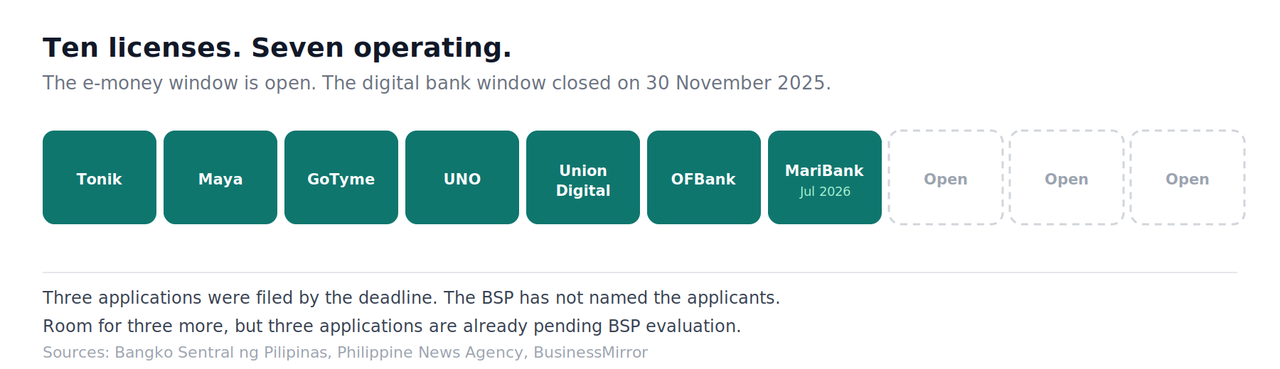
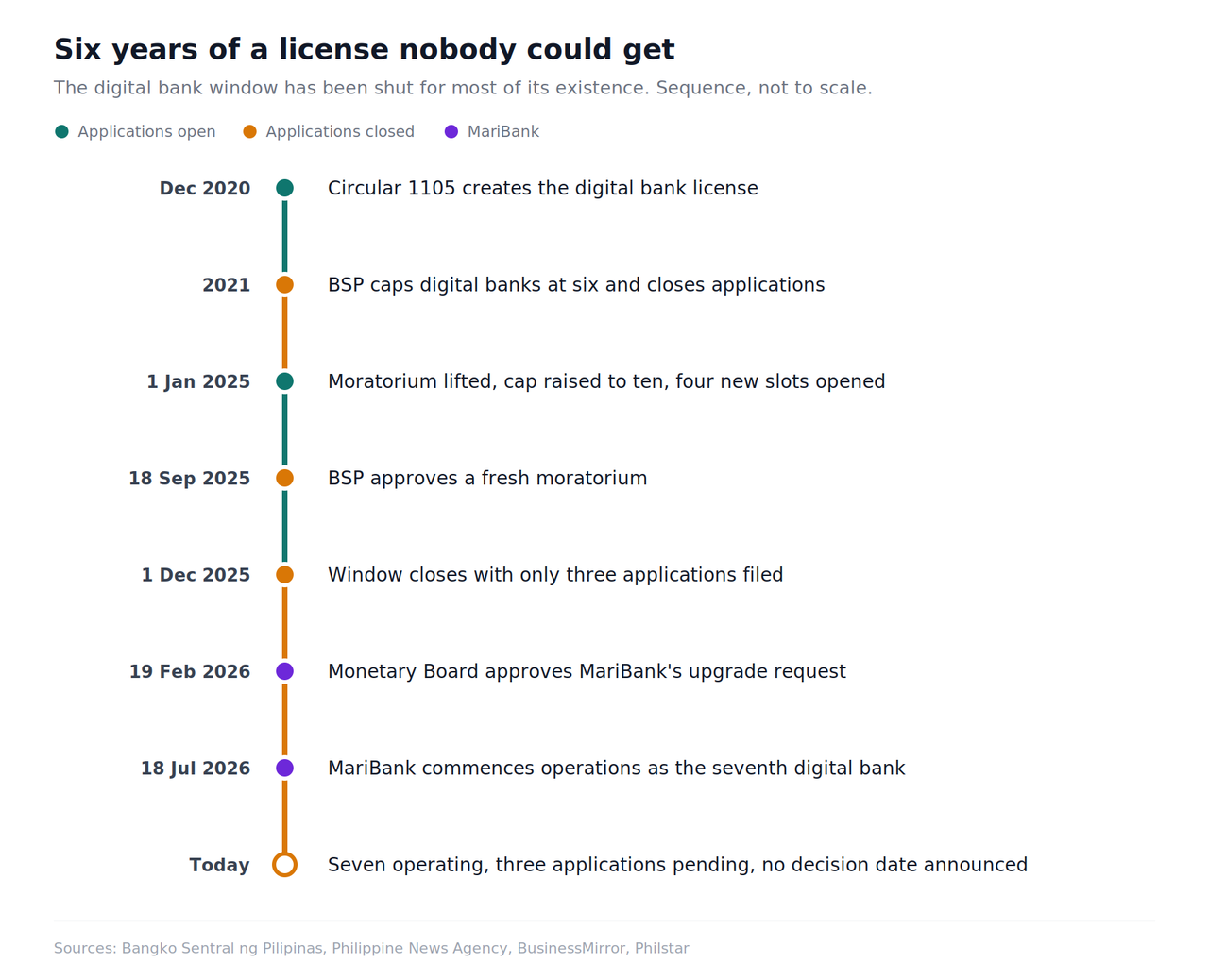
Seven digital banks currently operate under a ten-bank cap: Tonik, Maya Bank, GoTyme, UNO, OFBank, UnionDigital and MariBank. That leaves room for three more, but the filing window is closed and three applications submitted before the 30 November 2025 deadline remain under BSP evaluation. Those are not three freely available slots. As of July 2026 the BSP had not announced a firm decision date.
So you want to build financial services in the Philippines. What are your routes?
What each license costs to hold
| License | Minimum capital | Ongoing obligations |
| Digital bank | P1,000,000,000 under Circular 1105 | Full banking prudential regime |
| EMI, large scale | P200,000,000, for issuers meeting the P25 billion combined 12-month inflow and outflow threshold under Circular 1166 | Trust and eligible-liquid-asset safeguarding tied to outstanding e-money balances |
| EMI, small scale | P100,000,000 | Safeguarding requirements against the float |
| Rural bank | P50,000,000 up to five branches, P120,000,000 for six to ten, P200,000,000 above ten, under Circular 1151 | Lighter, with branch obligations |
The headline minimum for a digital bank is five times that of a large-scale EMI, before considering the different prudential and safeguarding obligations on each side. Circular 1166's safeguarding regime is worth reading in full rather than summarizing: it imposes trust and liquid-asset requirements tied to outstanding e-money balances, and the economic weight of that depends on permitted investments, yields and liquidity needs. Treat it as an opportunity and liquidity cost rather than a fixed price.
The five routes
| Route | Capital floor | What you get | What it costs you |
| EMI license | P100M to P200M | Payments, stored value, QR acceptance, distribution | No interest on the e-money balance, no deposits, no lending from float, plus safeguarding requirements |
| Digital bank license | P1B | Deposit-taking and direct lending | Filing window closed, three applications pending, heavier prudential regime |
| Acquire a bank, then convert | Rural bank floor now, P1B at conversion | A banking platform before seeking conversion | Acquisition cost and integration, with BSP approval required throughout. Conversion is not automatic |
| Partner with a licensed bank | None of your own | Bank capabilities under your interface, quickly | You do not hold the balance sheet or the margin |
| Financing company under the SEC | Set by SEC requirements for the entity, materially below either BSP floor | Consumer credit without a banking license | Solves lending only. No deposits, no interest, no deposit insurance |
Most entrants combine these rather than picking one. GCash operates an EMI, a financing company and bank partnerships. Maya's group holds an e-money license and a banking license in separate companies.
A product hypothesis worth testing
One implication we would flag as a hypothesis rather than a finding: because a Philippine consumer's liquidity can sit across more than one regulated entity, with a transfer step between them, an insufficient wallet balance at checkout may be a routing problem rather than a payment failure. We have not measured how often that is true. Anyone designing checkout here should test it against their own abandonment and insufficient-balance data before building around it.
References and sources
- BSP Circular No. 1166, Series of 2023. Amendments to the regulations on electronic money and the operations of electronic money issuers. Definition of e-money as non-interest-bearing, non-deposit stored value; EMI classification and capitalization; safeguarding and trust requirements; removal of the P100,000 aggregate monthly load limit. https://naro.law.upd.edu.ph/documents/412
- BSP Circular No. 1105, Series of 2020. Guidelines for the establishment of digital banks. Digital bank as a distinct license category with a P1 billion minimum capitalization.
- BSP Circular No. 1151, Series of 2022. Rural bank minimum capitalization tiers of P50 million, P120 million and P200 million by branch count.
- Philippine Deposit Insurance Corporation. New Maximum Deposit Insurance Coverage. P1 million per depositor, per bank, effective 15 March 2025, and the scope of PDIC protection. https://www.pdic.gov.ph/mdic
- Bangko Sentral ng Pilipinas. Financial system statistics and BSP Verifier. Current count of seven operating digital banks; institution categories for banks, EMIs, operators of payment systems and money service businesses. https://www.bsp.gov.ph/Statistics/Financial%20System%20Accounts/tab23_nfi.aspx
- Philippine News Agency (2024). BSP to resume granting of licenses to digital banks. Ten-bank cap and four available slots effective 1 January 2025. https://www.pna.gov.ph/articles/1230770
- Philippine News Agency (2025). BSP to close digital bank application by December 2025. Applications stopped effective 1 December 2025. https://www.pna.gov.ph/articles/1259602
- BusinessWorld (December 2025). BSP receives three digital banking license applications. Three applications filed by the deadline; applicants not identified. https://www.bworldonline.com/top-stories/2025/12/29/721308/bsp-receives-three-digital-banking-license-applications/
- Philstar (July 2026). New digital bank licenses still under review, BSP. No firm decision date announced. https://www.philstar.com/business/2026/07/10/2541030/new-digital-bank-licenses-still-under-review-bsp/amp/
- Philstar (July 2026). BSP grants digital bank license to MariBank. Conversion sequence and commencement as the seventh digital bank. https://www.philstar.com/business/2026/07/23/2544177/bsp-grants-digital-bank-license-maribank
- MariBank Philippines. What is MariBank and product pages, including MariCard Credit and PDIC coverage disclosure. Formerly SeaBank Philippines; part of Sea Limited. https://www.maribank.ph/help-center/article/10001
- GCash Help Center. What is GSave and Who is the lender of my GLoan. Current GSave partner banks; GLoan creditor identified in the disclosure statement and may be Fuse Financing, Inc. or a partner financial institution. https://help.gcash.com/hc/en-us/articles/47625134131097-What-is-GSave and https://help.gcash.com/hc/en-us/articles/30654917327129-Who-is-the-lender-of-my-GLoan
- Maya. Official product pages for Maya Savings, Maya Easy Credit, Maya Personal Loan and Maya Credit Card, including the Maya Philippines, Inc. and Maya Bank, Inc. entity distinction and PDIC coverage disclosure. https://www.maya.ph/
- GoTyme Bank. About us, What is MoreTyme, and product pages. Gokongwei Group and Tyme Group relationship; installment and payment functionality. https://www.gotyme.com.ph/about-us
- BusinessWorld (27 November 2025). GoTyme Bank targets 50% loan growth. Deposits of about P40 billion and loans of about P6 billion as of November 2025. https://www.bworldonline.com/banking-finance/2025/11/27/714783/gotyme-bank-targets-50-loan-growth/
- SunStar (2021). GCash not planning to have digital bank yet. Martha Sazon's 2021 statement.
- Reuters (2 August 2024). *Philippine's Mynt gets valuation boost at $5 bln with Ayala, MUFG funding.*Approximately USD 393 million each from MUFG and the Ayala transaction. https://www.reuters.com/markets/deals/philippines-mynt-gets-valuation-boost-5-bln-with-ayala-mufg-funding-2024-08-02/
- BusinessWorld (2024). GCash hesitant on digital bank license. Reyes on governance requirements and on lending without a banking license.
- Mynt, Inc. (27 June 2026). GCash parent Mynt authorizes filing for potential initial public offering on the Philippine Stock Exchange. Offer representing about 12% of post-IPO shares. https://mynt.com.ph/newsroom/gcash-parent-mynt-authorizes-filing-for-potential-initial-public-offering-on-philippine-stock-exchange
- BusinessWorld (27 August 2026). GCash parent Mynt shifts timetable for IPO listing. Updated prospectus dated 18 August 2026: offer period 6 to 12 October, listing 20 October, up to 9.23 billion shares at up to P10, gross proceeds up to P92.3 billion; Mynt described as a partnership among Globe Telecom, Ayala Corp. and Ant International, operating GCash through G-Xchange, Inc. and lending through Fuse Financing, Inc. https://bworldonline.com/banking-finance/2026/08/27/772644/gcash-parent-mynt-shifts-timetable-for-ipo-listing/
- BPI (2026). Advisory on deactivation of linked BPI accounts in partner e-wallet applications, January 2026.
- Fintech News Philippines (2026). Reporting on the shift of e-wallet and digital bank transfers onto InstaPay under BSP and PPMI rules, and on 2026 InstaPay fee changes.
This article is a research summary, not legal advice. Product-specific details, limits, rates and lender identities change; check the provider's current disclosures and the controlling BSP issuance before relying on any figure here.