Field Notes from Indonesia - Volume 2
Amanda Hillary Husain is Bytecenture's Indonesia-based payment UX researcher. This is the second in a series of Field Notes from our in-market researchers across ten countries.
In Indonesia, a voucher can attract the click. An unpredictable final total can still lose the sale.
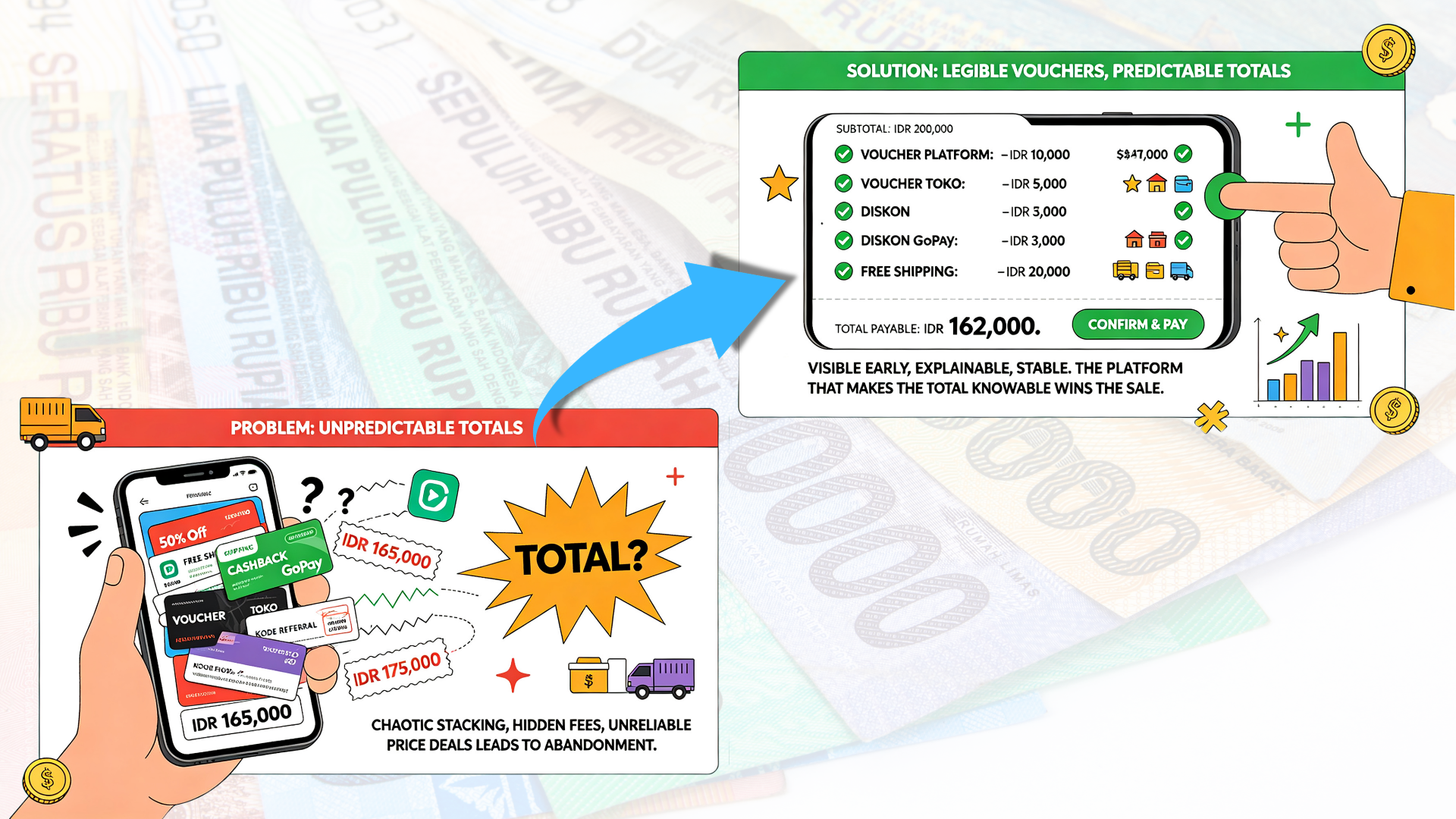
Shoppers may arrive at checkout with a store coupon, platform voucher, free-shipping offer, cashback, referral code, and payment-method promotion all attached to the same order. Each layer appears to improve the deal. The problem begins when eligibility rules, minimum-spend thresholds, shipping charges, service fees, or payment selection change the amount at the final step.
The question is not whether voucher stacking works. In Indonesia, it clearly does.
The sharper question is whether the shopper can confidently predict what they will actually pay.
The stacking logic
Voucher stacking is not a corner case. It is part of how many Indonesian shoppers evaluate online purchases.
The product price is only the starting point. The final decision often depends on the combined effect of store coupons, marketplace vouchers, shipping subsidies, cashback, referral codes, and payment-method discounts. A shopper comparing the same item across Shopee, TikTok Shop, Tokopedia, or another commerce app is not only comparing the listing price. They are comparing the payable total after the stack resolves.
This matters because Indonesia is an unusually promotion-responsive market.
NielsenIQ's study of Indonesia's 12.12 Mega Sales period found that free shipping and discounts were the joint top drivers of online Mega Sales purchases, each cited by 70% of surveyed internet users. Online sales during the Mega Sales week reached IDR 31.2 trillion, around 6.6 times average daily sales.
Neither free shipping nor a discount is a product attribute. Both are promotional levers.
That is the point: in Indonesian e-commerce, promotions do not merely sweeten the purchase. They help define the purchase.
Why predictability matters
A discount stack is a promise.
The shopper believes the combination of voucher, shipping offer, cashback, and payment discount will resolve into one lower final number. When that number changes late, the promise breaks.
Global checkout research helps explain why this is so damaging. Baymard Institute's checkout research finds that extra costs such as shipping, tax, and fees are the leading fixable reason shoppers abandon checkout. Baymard reports that 39% of shoppers who abandoned for actionable reasons did so because extra costs were too high, and another meaningful share left because they could not see the total order cost upfront.
Those figures are not Indonesia-specific. But the mechanism is especially important in Indonesia because comparison often happens at the last mile.
Many shoppers already know how to compare across platforms. They may add the same item to multiple carts, walk each cart to checkout, and then choose the platform with the best final payable amount. In that situation, the listing price is not the battlefield. The checkout total is.
If the final number moves after the shopper has mentally accepted the deal, the platform has not only made the order more expensive. It has made the deal feel unreliable.
The trust deficit
The damage from a late-stage total change is often larger than the amount itself.
A recalculated shipping fee, newly visible service fee, removed voucher, payment-method surcharge, or cashback rule that no longer applies may only change the order by a small amount. But the shopper experiences it as a loss against the price they had already anchored on.
That is why hidden or late-revealed costs feel different from ordinary price increases. The shopper does not simply see a higher price. They see a promise being withdrawn.
In a promotion-heavy market, that trust loss matters. Discounts are supposed to reduce hesitation. If the discount stack becomes hard to predict, it creates a new hesitation at the most fragile moment in the funnel.
The result looks like checkout abandonment. The cause is not always friction. Often, it is broken price confidence.
The payment layer complicates the stack
Indonesia's payment mix makes this problem harder.
A checkout may need to support digital wallets such as GoPay, DANA, OVO, and ShopeePay; QRIS; virtual accounts; buy-now-pay-later; cards; and cash-on-delivery. Each method can carry its own promotion, fee structure, cashback rule, eligibility requirement, or minimum-spend condition.
That means the best deal is rarely a simple function of product price.
It is a function of product price plus voucher eligibility plus shipping rule plus service fee plus payment method.
Every added variable is another place where the final number can move.
The payment method menu is therefore not only a payments interface. It is part of the pricing interface. If a shopper changes from one wallet to another, or from wallet to virtual account, the total may change. If that change is not shown clearly before the final confirmation, the user has to recalculate under pressure.
That is bad UX, even when every charge is technically disclosed.
Designing for a predictable payable total
The fix is not fewer vouchers. It is more legible vouchers.
The most damaging failure mode is not the existence of a complex stack. It is the late-stage reversal, where the shopper only discovers at the final screen that the deal they expected is not the deal they can complete.
Merchants and platforms should make the payable total visible, explainable, and stable earlier in the journey.
That means showing shipping, service fees, payment-method rules, voucher eligibility, and cashback conditions before the shopper reaches the last step. If the total cannot be final yet, the interface should show what can still change and why.
For example:
- show whether a voucher is applied, pending, or ineligible
- explain the exact reason a voucher cannot be used
- preview how the total changes when the user selects each payment method
- keep free-shipping progress visible and specific
- separate immediate discounts from delayed cashback
- avoid showing a promotional number that cannot survive checkout
The goal is not to make the promotion system simple. The goal is to make the outcome knowable.
Why this matters now
The stakes are rising because Indonesia's commerce and payment markets are still expanding quickly.
Google, Temasek, and Bain's e-Conomy SEA 2025 report says Indonesia's digital economy is approaching US$100 billion in GMV in 2025, with digital payments projected to reach US$538 billion in gross transaction value. Bank Indonesia has also reported rapid QRIS growth, with 12.55 billion QRIS transactions in the first half of 2026 across roughly 66 million users and 44.9 million merchants.
As more of the market moves through digital payment rails, the checkout screen becomes the place where promotions, payment choice, trust, and price confidence converge.
That makes final-total predictability a competitive metric.
In Indonesia, the platform that makes the payable amount easiest to understand may win even when its listing price is not the lowest.
What is still open
Several questions are worth watching.
First, the best design response may vary by category. For high-ticket items, shoppers may tolerate more comparison work. For groceries, food, and daily essentials, even small uncertainty in the final total may be enough to push the user elsewhere.
Second, platforms need to decide whether voucher complexity is a feature to expose or a complexity to absorb. Some users enjoy optimizing the stack. Others only want to know the final number. Treating both users the same will weaken the experience for one of them.
Third, payment-method promotions create a ranking problem. If the cheapest final total depends on the selected payment method, then payment ordering should not be static. It should help users find the method that makes the order most valuable for them.
The bottom line
Voucher stacking is not the problem.
The problem is that the stack promises a number the shopper can no longer see coming.
For Indonesian checkout, the winning experience is not simply the one with the largest discount. It is the one where the shopper can understand the discount, trust the total, and complete the payment without discovering a new condition at the final step.
The platform that makes the final total predictable wins the comparison. The one that lets it drift loses the trust it just spent a discount buying.
The best discount is the one the shopper can already see coming.
References and Sources
- NielsenIQ Indonesia. Indonesia Mega Sales: 5 Key Consumer Insights to Win the E-Commerce Peak. Source for the December 2024 12.12 survey across 41 Indonesian cities, 1,016 respondents, free shipping and discounts each at 70% as purchase drivers, and IDR 31.2 trillion in Mega Sales revenue. nielseniq.com
- Baymard Institute. How to Reduce Cart Abandonment (Data-Backed UX Strategies). Source for global checkout-abandonment benchmarks, including extra costs as the leading fixable abandonment driver. baymard.com
- Baymard Institute. UX Statistics. Source for Baymard's broader cart-abandonment benchmark and total-cost visibility findings. baymard.com
- Google, Temasek, and Bain & Company. e-Conomy SEA 2025 - Indonesia. Source for Indonesia's digital economy approaching US$100 billion in GMV in 2025 and digital payments projected at US$538 billion in GTV. blog.google
- Bank Indonesia. BI Optimistic That Digital Economy and Finance Growth Will Continue. Source for QRIS transaction growth, user count, and merchant count reported in 2026. bi.go.id
- Tempo / Antara. QRIS Transaction Value Soars 100% in First Half of 2026. Source for reported H1 2026 QRIS volume of 12.55 billion transactions, transaction value, user count, and merchant count. tempo.co
- Worldpay. Global Payments Report 2026. Source for Indonesia payment-method context and the continuing shift from cash toward digital wallets, account-to-account payments, and other digital rails. worldpay.com