Field Notes from the Philippines - Volume 4
Jasmine Paras is Bytecenture's Philippines-based payment UX researcher. This is the fourth in a series of Field Notes from our in-market researchers across ten countries.
Fact-checked and updated through 4 September 2026
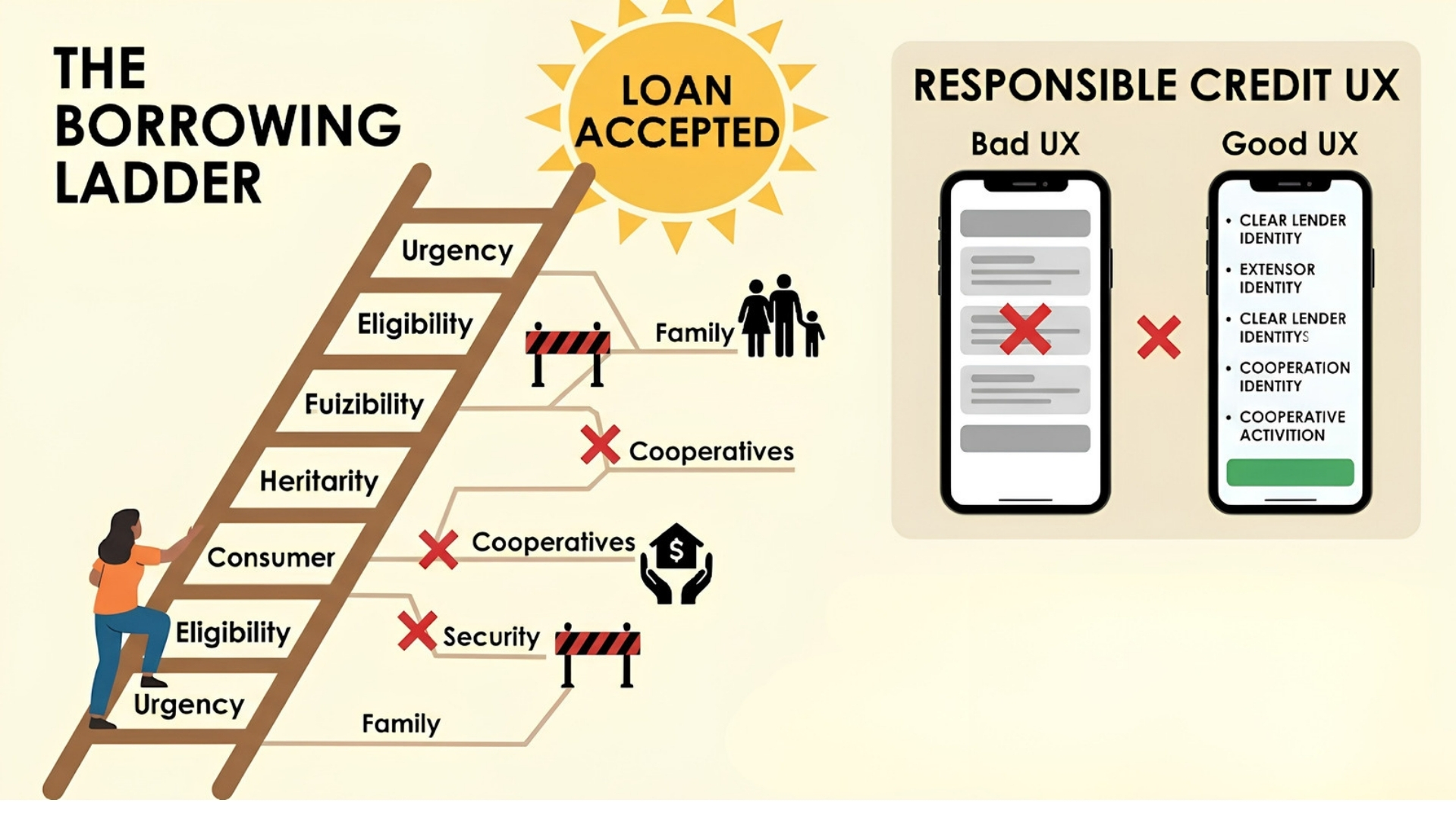
If you are launching consumer credit in the Philippines, your competition is not only another app. It can be a relative, a cooperative, a government-backed loan, a pawnshop, a financing company, a bank, or an informal moneylender. But there is no evidence that every Filipino follows one fixed borrowing ladder. A more defensible conclusion is that borrowers trade off eligibility, speed, repayment period, price, documentation, privacy, and social cost, and that the first lender to say yes can matter a great deal.
That distinction matters. The 2025 Consumer Finance and Inclusion Survey (CFIS) says borrowers prioritize fast loan processing and approval, followed by repayment period; interest rate and ease of application also matter. Price is important, but it is not the only decision variable.[1]
Something real changed between 2021 and 2025
For a decade, Philippine borrowing looked heavily informal when measured by where borrowers sourced money. In the BSP's 2015 baseline survey, among adults who borrowed, 61.9% used family, relatives or friends, 10.1% used informal lenders, and 4.4% borrowed from a bank. In the 2021 Financial Inclusion Survey, 45% of adults had outstanding loans; among borrowers, 57% used informal sources and 4% borrowed from banks.[2, 3]
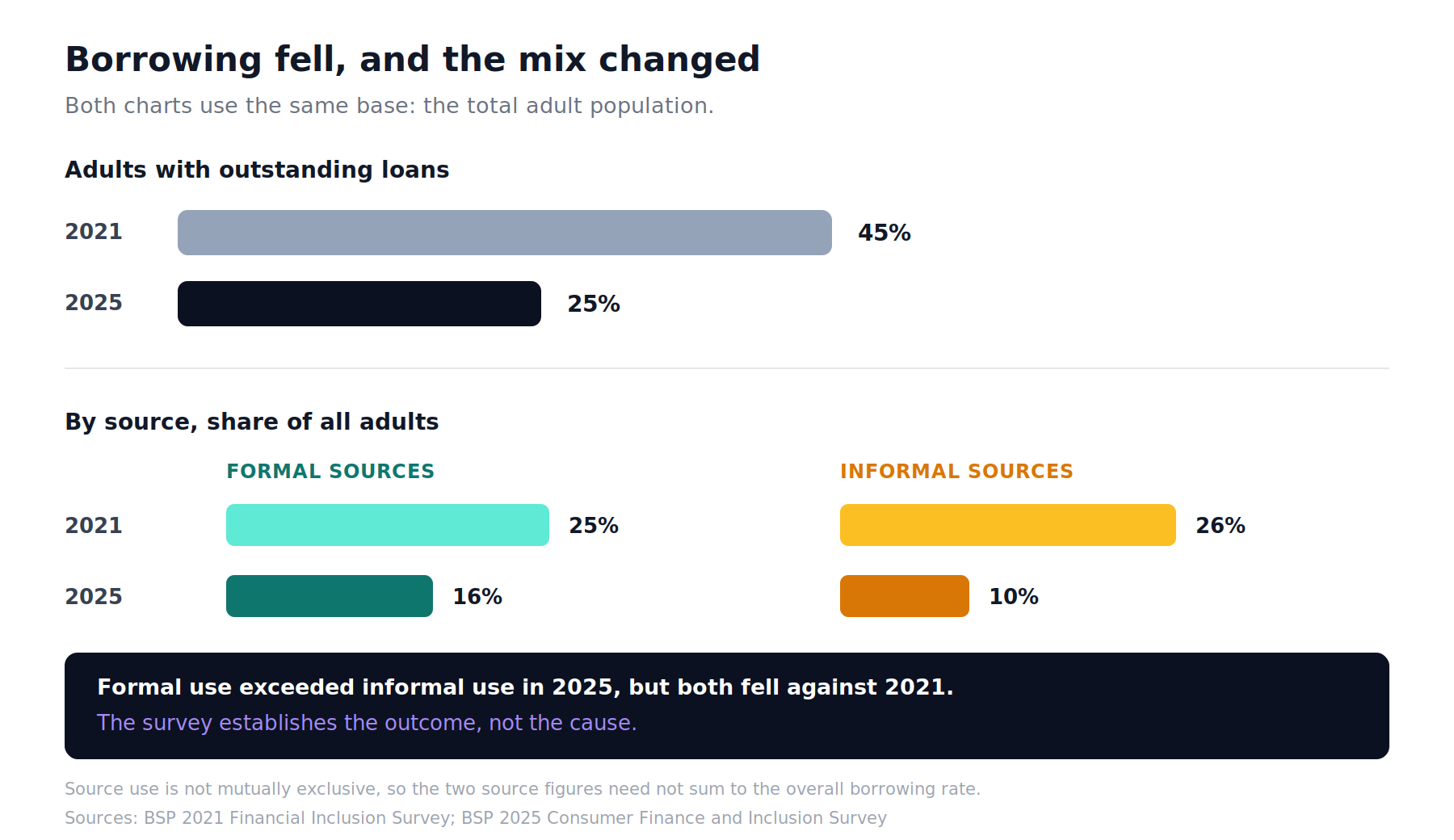
The 2025 CFIS shows a different composition. Only 25% of Filipino adults had outstanding loans, down from 45% in 2021. Using the same denominator, the total adult population, formal-source borrowing fell from 25% in 2021 to 16% in 2025, while informal-source borrowing fell from 26% to 10%. Formal borrowing therefore exceeded informal borrowing in 2025, but the shift happened while borrowing overall contracted sharply.[1]
| Measure (base: total adult population) | 2021 | 2025 |
| Adults with outstanding loans | 45% | 25% |
| Used formal borrowing sources | 25% | 16% |
| Used informal borrowing sources | 26% | 10% |
Source: BSP 2025 CFIS. Formal and informal source use are not mutually exclusive, so source percentages need not sum exactly to the overall borrowing rate.
THE DENOMINATOR TRAP. Do not compare "57% of borrowers used informal sources" in 2021 directly with "10% of adults used informal sources" in 2025. Those figures use different bases. The cleaner time comparison is 26% of all adults using informal sources in 2021 versus 10% in 2025, and 25% versus 16% for formal sources.[1, 2]
What caused the decline is not established by the survey. It could reflect lower demand, tighter supply, changing household conditions, regulation, or several factors at once. It is therefore too strong to say that rate caps, app-store enforcement, or the online-lending moratorium caused the fall. The data establish the outcome, not the causal mechanism.
A borrowing ladder is useful as a heuristic, not a universal rule
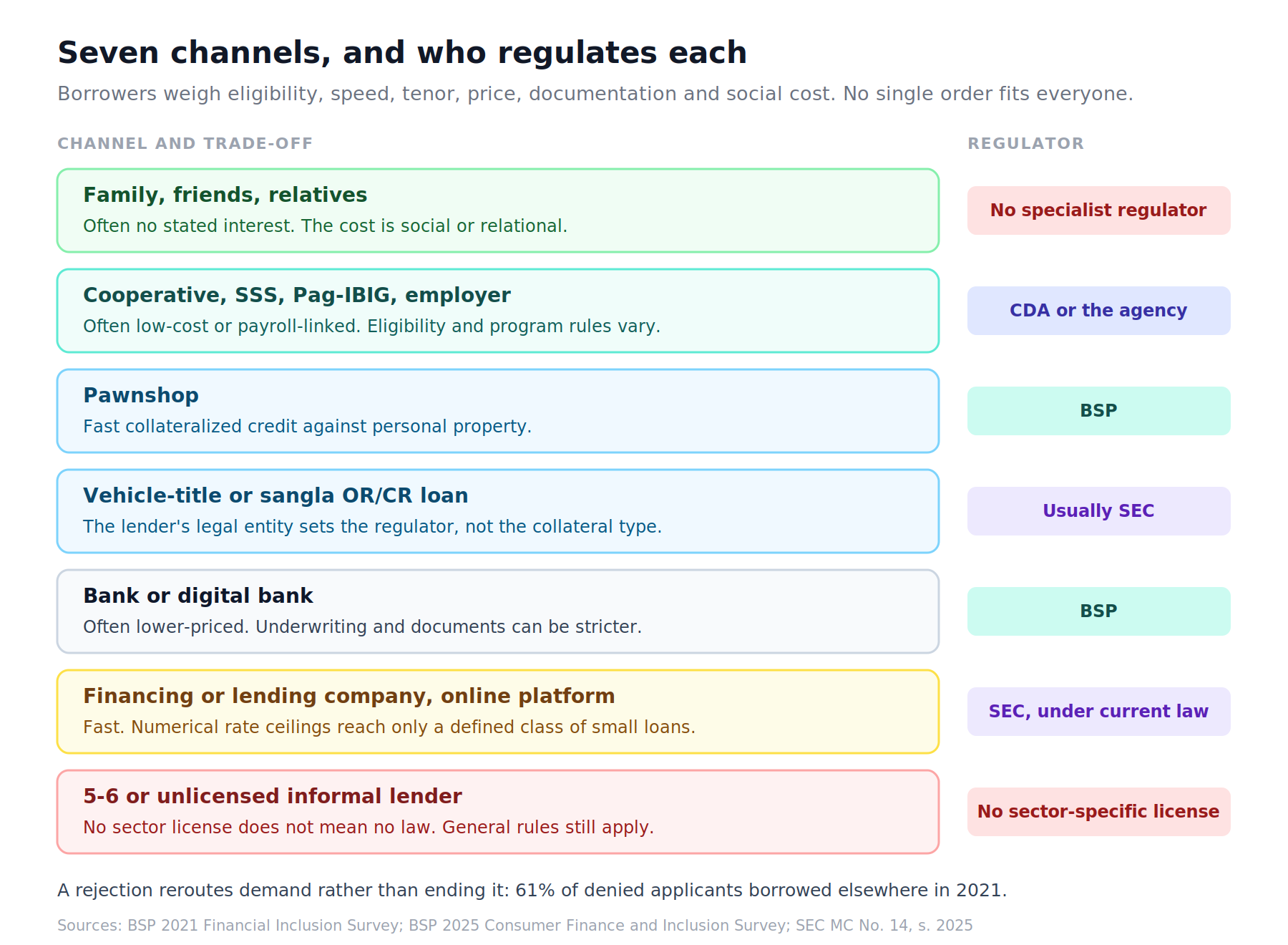
The original ladder idea is useful if treated as a product-strategy heuristic: borrowers may move across channels as eligibility, urgency, documentation and social friction change. What the national survey actually supports is that speed, repayment period, interest rate and ease of application all shape borrowing decisions. It does not establish one fixed order followed by everyone.[1]
| Channel | Who primarily regulates it | A more accurate trade-off |
| Family, friends, relatives | No specialist financial regulator | Often no stated interest, but the cost can be social or relational. Ordinary contract and other generally applicable laws can still matter. |
| Cooperative, SSS, Pag-IBIG, employer | CDA, the relevant government agency, or rules governing the employer arrangement | Can be relatively low-cost or payroll-linked, but eligibility, membership and program rules vary. |
| Pawnshop or pawn loan | BSP | Fast collateralized credit against personal property. Pawnshops are BSP-supervised institutions. |
| Vehicle-title or sangla OR/CR loan | Depends on the lender; many providers are SEC-regulated financing or lending companies | Do not classify the product as BSP-regulated merely because a vehicle is collateral. The legal entity providing the loan determines the regulator. |
| Bank or digital bank | BSP | Often offers lower-priced credit than high-cost short-term lenders, but underwriting and documentary requirements can be stricter. |
| Financing or lending company, online lending platform | SEC under current law | Digital channels can be fast. Only a defined class of small, short unsecured loans is subject to the SEC numerical rate ceilings described below. |
| 5-6 or unlicensed informal lender | No sector-specific lending license | No specialist regulator does not mean "no law." General civil, criminal, privacy and consumer rules can still apply depending on the conduct. |
Regulator status is based on the provider and legal product, not the colloquial name of the borrowing method. Pawnshops are BSP-supervised; financing and lending companies remain SEC-supervised as of 4 September 2026.
A decline is often a rerouting event
The 2021 FIS gives the strongest evidence for the rerouting idea. Among people whose loan applications were denied, 61% went on to source a loan from another provider. Of those who looked elsewhere, family, friends and relatives were the most common alternative, followed by informal lenders. A rejection can therefore shift demand to another channel rather than eliminate it.[2]
Repayment stress was also material in 2021: 32% of borrowers said they often had difficulty paying their loans, while 9% had obtained another loan to pay an existing one. Those are survey findings, not proof that all borrowers are debt-stressed, but they are important context for any lender entering the market.[2]
What a loan is legally allowed to cost, current as of September 2026
The old shorthand that "the Philippines had no usury ceiling" needs a legal qualifier. Central Bank Circular No. 905 removed the Usury Law ceilings effective 1 January 1983. But that did not make every agreed interest rate automatically enforceable: Philippine courts have continued to strike down or reduce rates they find excessive, iniquitous or unconscionable.[4]
A targeted numerical ceiling returned for a specific class of loans in 2022. As of 1 April 2026, SEC Memorandum Circular No. 14, Series of 2025, recalibrated that ceiling for covered financing and lending company loans. The previous 15% monthly effective-interest ceiling under SEC MC No. 3 is no longer the current ceiling for loans within MC 14's prospective scope.[5]
| Current SEC ceiling for covered loans | Limit |
| What is covered | Unsecured, general-purpose loans offered by financing or lending companies, principal not exceeding P10,000, term up to four months; applies to covered loans entered into, restructured or renewed beginning 1 April 2026 |
| Nominal interest | Maximum 6% per month, about 0.20% per day |
| Effective interest rate | Maximum 12% per month, about 0.40% per day, including nominal interest plus other fees and charges, excluding late-payment penalties |
| Late or non-payment penalty | Maximum 5% per month on the outstanding scheduled amount due |
| Total cost cap | All interest, fees, charges and penalties combined may not exceed 100% of the amount borrowed, regardless of how long the loan remains outstanding |
SEC Memorandum Circular No. 14, Series of 2025, effective for covered transactions from 1 April 2026.
WHAT "OUTSIDE THE CAP" MEANS. A loan above P10,000, longer than four months, secured, or otherwise outside MC 14's defined scope is outside this particular numerical ceiling. That is not the same as being law-free or automatically enforceable at any price. Disclosure, consumer-protection, contract, privacy and unconscionability rules can still apply.[4, 5]
Credit cards sit under a separate BSP regime. BSP Circular No. 1165 raised the ceiling on unpaid credit-card balances from 2% to 3% per month, or 36% per year, effective in 2023. Credit-card installment loans remain subject to a maximum monthly add-on rate of 1%, and cash-advance processing fees are capped at P200 per transaction. So 2% per month is outdated as a current benchmark.[6]
The harassment problem, and what regulation actually targets
The collection-abuse story is real, but it should not be written as if every lending app behaves this way. In 2019 the National Privacy Commission (NPC) summoned 67 online lenders by publication amid complaints of debt shaming and misuse of personal data. In October that year, the NPC imposed a ban on personal-data processing against operators of 26 online lending applications and ordered their online operations taken down while cases were pending. By November, new formal complaints had fallen by 90% from the September peak.[7, 8]
The abusive pattern the rules target is specific: unnecessary or disproportionate access to a borrower's data, harvesting contacts, and using third parties for harassment, public shaming or debt collection. The March 2026 DICT, NPC and SEC joint advisory again prohibited unauthorized, excessive or disproportionate processing and said that, for debt collection, lenders may not contact people in the borrower's contact list other than declared guarantors.[9]
A permission tap is not a blank cheque
The Data Privacy Act does not say that borrower consent is the only possible lawful basis for every piece of personal-data processing; Section 12 recognizes several lawful criteria. What consent cannot do is erase the principles of transparency, legitimate purpose and proportionality, or let a borrower consent on behalf of an unrelated third-party data subject.[10]
NPC Circular No. 2022-02 makes the loan context more concrete. Lenders must give just-in-time notices before obtaining consent for loan-related processing, avoid unnecessary permissions, and stop access when the purpose has been achieved unless another lawful basis remains. Processing used for identity or truthfulness checks must not be unbridled, excessive or disproportionate.[11]
Character references and guarantors are also different. A character reference is not automatically a guarantor. The lender must inform the reference that they were named, explain how the contact details were obtained, and provide an option to have the data removed as a character reference. A guarantor must separately consent and expressly bind themselves to the obligation. For debt collection, the lender may contact declared guarantors, not arbitrary people from the borrower's contact list.[11]
THE THIRD-PARTY DATA RULE, STATED PRECISELY. A borrower cannot give consent on somebody else's behalf unless legally authorized to do so. But that does not mean third-party data can never be processed without that person's consent; the Data Privacy Act recognizes other lawful bases. In lending, the NPC's specific rules sharply restrict contact-list use and require separate consent for guarantors.[10, 11]
The privacy law also has extraterritorial reach, but not universal jurisdiction. Section 6 of the Data Privacy Act can apply to acts outside the Philippines when the data concern a Philippine citizen or resident and the entity has the required Philippine link or nexus described by the statute. It is more accurate to say privacy law can reach some offshore operators than to say privacy regulation "does not run out of jurisdiction."[10]
It is not solved
Illegal and abusive operators remain a live enforcement problem. In January 2026, the SEC reported 22 online lending apps operating on Google Play without the necessary permits. In March, the DICT, NPC and SEC issued a joint advisory after receiving reports of harassment, intimidation, public shaming and unlawful use of personal data by online lending platforms.[9, 12]
In July 2026, the SEC fined Inclusive Credit Lending, Inc. P1.03 million over its Pinoy Peso platform. The regulator found that a 38% upfront deduction translated to a seven-day effective interest rate of 61.29%, equivalent to 262.67% per month, and also found unfair collection practices. The order cited SEC MC No. 3's 15% ceiling for the transactions at issue. Separately, the current prospective cap under MC No. 14 is 12% per month for covered loans within its scope.[13, 5]
The regulator may change, but it has not changed yet
Under current law, financing and lending companies remain primarily supervised by the SEC under the Financing Company Act and the Lending Company Regulation Act. In April 2026, SEC Commissioner Rogelio Quevedo said he had submitted a position paper to Congress seeking to transfer the function to the BSP. That is a policy proposal, not a completed transfer.[14, 15]
A separate 2026 change is already final: SEC Memorandum Circular No. 20, Series of 2026, lifted the moratorium on new online lending platforms effective 1 August 2026. The moratorium had been in place since 5 November 2021. The final framework caps the number of online lending platforms an entity may operate at five and imposes licensing, disclosure, consent, privacy, market-conduct and capitalization requirements.[16]
Embedded wallet credit: the wallet is not necessarily the lender
GCash is a useful example of why brand, channel and lender should be separated. Current GLoan terms state that the contract is between the borrower and Fuse Financing, Inc., a financing company registered with the SEC. GCash also says some qualified GLoan accounts may be with or transferred to partner financial institutions, and tells users to check the loan's Disclosure Statement to identify the actual lender.[17, 18]
That means "a loan inside an e-wallet" should not automatically be described as a bank loan or as a loan made by the wallet operator itself. The governing regulator and product rules follow the legal lender and the specific loan. For GLoan, offers and tenors vary by borrower; if a particular offer exceeds P10,000 or four months, it falls outside MC No. 14's small-loan numerical ceiling because it fails at least one of the coverage thresholds. Other applicable laws and disclosure duties still remain.[5, 17, 18]
A financing-arm structure creates a different regulatory perimeter from a bank, but that alone does not establish that the business is exploiting a loophole or that it is cheaper to operate because of lighter regulation.
What this means if you are building credit here
Speed matters, but do not turn a preference into a universal rule
The strongest national evidence is straightforward: borrowers prioritize fast processing and approval; repayment period is close behind; interest rate and ease of application also matter. A fast product can therefore beat a cheaper but slower one for some users, especially under urgency. But the survey does not prove that speed always beats price or that all borrowers descend the same ladder.[1]
Treat a decline as a routing decision in your research
The 2021 denied-application result is commercially important. If your model declines a user, research what they do next rather than treating the journey as ended. Some will stop, but many will seek another provider. That makes post-decline behavior a product, policy and consumer-protection question, not merely a funnel metric.[2]
Price against the rule you actually fall under
If you offer an unsecured, general-purpose loan of P10,000 or less for up to four months through an SEC-regulated financing or lending company, design to MC No. 14's current ceilings. If your product is outside that class, do not describe it simply as "uncapped." Model the other applicable requirements: true and transparent disclosure, financial-consumer protection, fair collection, privacy, contract enforceability and any regulator-specific rules.[5, 9, 10]
Make lender identity and data use visible
For embedded credit, users should be able to tell who is legally lending, what regulator supervises that entity, what the effective cost is, when repayment is due, what happens on late payment, what data is accessed, and who may be contacted. Those details are not compliance footnotes; they are part of the trust experience.
What is settled, and what is still open
| Question | Accurate status as of 4 Sep 2026 |
| Does financing and lending company oversight move to the BSP? | Not yet. The SEC-to-BSP transfer is a proposal. Current statutes still place financing and lending companies primarily under SEC supervision. |
| Did the small-loan ceiling widen to P20,000 and six months? | No. The final 2025 circular effective in 2026 kept the covered thresholds at P10,000 and four months. |
| Is the 2021 online-lending moratorium still in force? | No. SEC MC No. 20 lifted it effective 1 August 2026, under a new framework that includes a five-platform cap per entity and stricter entry and conduct rules. |
| Did formal credit replace informal credit? | Formal-source use exceeded informal-source use in 2025, but both fell versus 2021. The data show a change in composition alongside a large contraction in borrowing; they do not establish a single cause. |
The bottom line
For borrowers, the cheapest loan on paper is not automatically the cheapest option in practice if it is unavailable, too slow, too short, socially costly, or structured around a repayment schedule the borrower cannot meet. But that does not mean price is secondary for everyone. The 2025 data say borrowers weigh speed, repayment period, interest rate and ease together.[1]
For anyone building here, Philippine consumer credit is neither simply "underserved" nor "fully met already." A substantial share of borrowing still occurs outside banks, and informal sources remain material even after a sharp decline. The opportunity is to become a trusted, legitimate option that is fast enough to compete, transparent enough to understand, and affordable enough to repay, without turning urgency or a borrower's social network into collateral.[1]
References and sources
Bangko Sentral ng Pilipinas. 2025 Consumer Finance and Inclusion Survey (CFIS).
https://www.bsp.gov.ph/Inclusive%20Finance/Financial%20Inclusion%20Reports%20and%20Publications/2025/2025CFISreport.pdf
Bangko Sentral ng Pilipinas. 2021 Financial Inclusion Survey Topline Report.
https://www.bsp.gov.ph/Inclusive%20Finance/Financial%20Inclusion%20Reports%20and%20Publications/2021/2021FISToplineReport.pdf
Bangko Sentral ng Pilipinas. National Baseline Survey on Financial Inclusion (2015).
https://www.bsp.gov.ph/Inclusive%20Finance/Financial%20Inclusion%20Reports%20and%20Publications/2015/NBSFIFullReport.pdf
Supreme Court E-Library. Advocates for Truth in Lending, Inc. v. Bangko Sentral Monetary Board, G.R. No. 192986.
https://elibrary.judiciary.gov.ph/thebookshelf/showdocs/1/55471
SEC Memorandum Circular No. 14, Series of 2025. Recalibrated Ceilings on Interest Rates and Other Fees Charged by Financing Companies and Lending Companies.
https://www.gmanetwork.com/news/money/economy/969232/sec-lowers-interest-rate-caps-for-loans-up-to-p10-000/story/
Bangko Sentral ng Pilipinas. Circular No. 1165, Series of 2023.
https://www.bsp.gov.ph/Regulations/Issuances/2023/1165.pdf
National Privacy Commission. NPC summons 67 online lenders by publication. https://privacy.gov.ph/news-2/
National Privacy Commission. NPC shuts down 26 online lending companies (21 Oct 2019). https://privacy.gov.ph/npc-shuts-down-26-online-lending-companies/
DICT, NPC and SEC. Joint Advisory on Online Lending Platforms (March 2026). https://privacy.gov.ph/wp-content/uploads/2026/03/DICT-NPC-SEC-Public-Advisory-on-Online-Lending-Platforms.pdf
Republic Act No. 10173, Data Privacy Act of 2012, including Sections 6, 11 and 12. https://lawphil.net/statutes/repacts/ra2012/ra_10173_2012.html
National Privacy Commission. NPC Circular No. 2022-02.
https://privacy.gov.ph/npc-amends-circular-on-the-processing-of-personal-data-for-loan-related-transactions/
Philippine News Agency. CICC starts crackdown on predatory lenders. https://www.pna.gov.ph/articles/1269815
Manila Bulletin. SEC fines Pinoy Peso operator over excessive rates, harassment (24 Jul 2026).
https://mb.com.ph/2026/07/24/sec-fines-pinoy-peso-operator-over-excessive-rates-harassment
Republic Act No. 9474, Lending Company Regulation Act of 2007.
https://lawphil.net/statutes/repacts/ra2007/ra_9474_2007.html
Philstar. SEC seeks transfer of lending firms' oversight to BSP (15 Apr 2026). https://www.philstar.com/business/2026/04/15/2520983/sec-seeks-transfer-lending-firms-oversight-bsp/amp/
GMA News. SEC lifts moratorium on new online lending platforms; SEC MC No. 20, Series of 2026, effective 1 Aug 2026. https://www.gmanetwork.com/news/money/companies/994049/sec-lifts-moratorium-on-new-online-lending-platforms/story/
GCash. GLoan Terms and Conditions.
https://gcash.com/terms-and-conditions/gloan-hc
GCash Help Center. Who is the lender of my GLoan?
https://help.gcash.com/hc/en-us/articles/30654917327129-Who-is-the-lender-of-my-GLoan
Bangko Sentral ng Pilipinas. Pawnshops are BSP-supervised institutions.
https://www.bsp.gov.ph/Pages/Regulations/GuidelinesOnTheEstablishmentOfBanks/RegistrationOfPawnshopsAndMoneyServiceBusiness.aspx?ID=1408
Cycle Financing Corp. Example of an SEC-regulated financing company offering a sangla OR/CR product.
https://cyclefinancing.ph/
This article is a research summary, not legal advice. Product-specific compliance should be checked against the actual regulator issuance, lender license, disclosure statement and transaction date.